
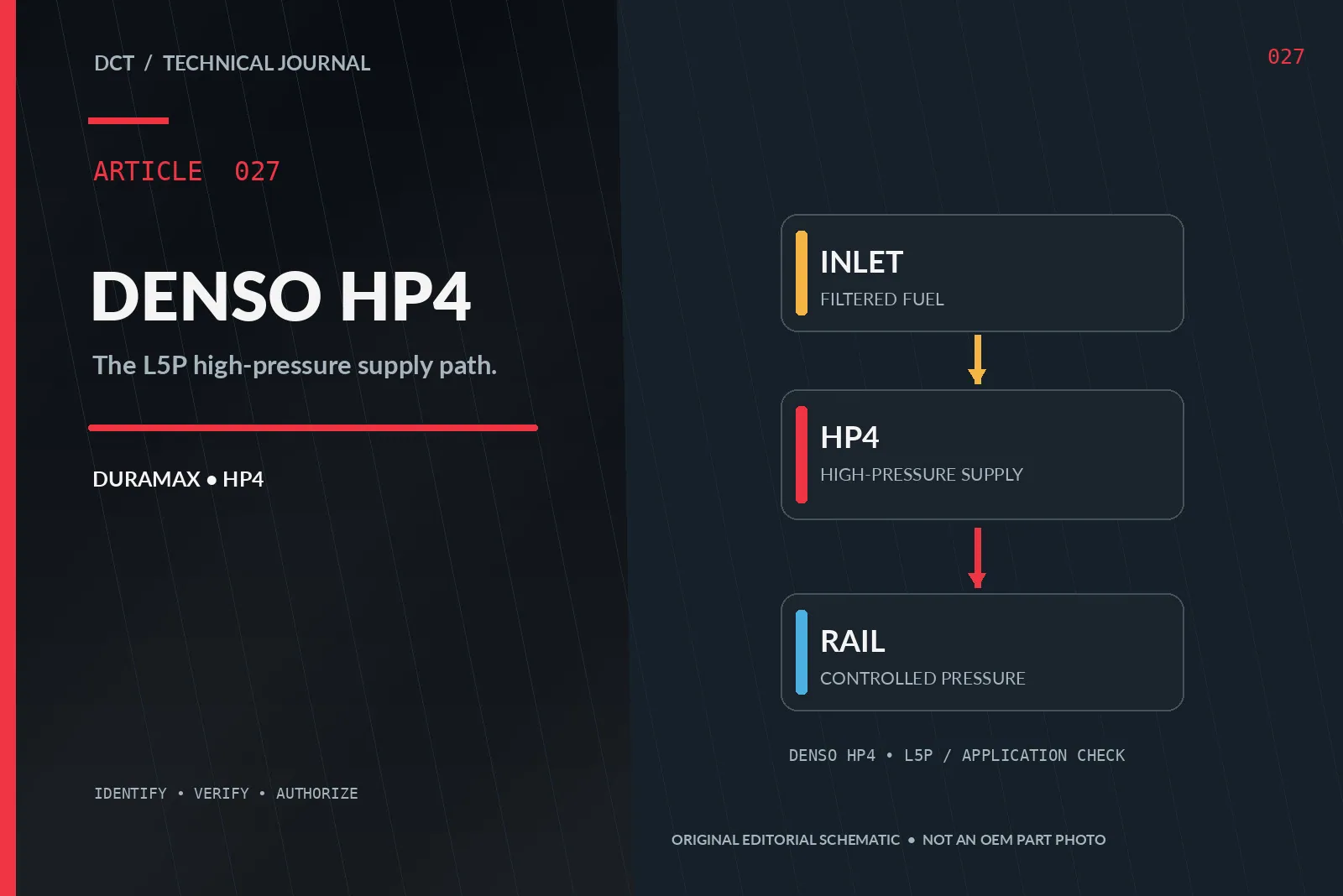
The Denso HP4 is the high-pressure pump on the L5P Duramax introduced for 2017, and it’s also used on off-road engines, including John Deere’s 9.0-liter PowerTech. Its problems fall into three buckets: contamination damage, metering-valve trouble and supply-side starvation. It hasn’t developed the reputation of the Bosch CP4 it replaced on the Duramax, but it’s still a precision pump that can’t tolerate water, dirt or air.
How the HP4 works
The HP4 is a cam-driven plunger pump that builds rail pressure for the common-rail system. Fuel enters through a suction control valve (SCV), an electrically controlled valve that meters how much fuel reaches the pumping chambers. The engine computer adjusts the SCV to hold the rail pressure it wants. More opening means more fuel pumped and higher rail pressure.
That design means many HP4 complaints are really rail-pressure control complaints, and the SCV and supply side deserve a look before the pump itself is condemned.
HP4-related symptoms
- Low rail pressure codes such as P0087, often first under heavy load
- Rail pressure that fluctuates around the desired value, felt as surging or hesitation
- Hard starting or extended cranking
- Reduced power or a derate when the computer protects the engine
- Electrical codes for the metering valve circuit
What usually causes them
Contaminated fuel. Water and abrasive particles damage the plungers, the SCV and the injectors. Contamination remains the most serious threat to an HP4, and a contaminated system often needs much more than a pump. GM offers a fuel-system contamination kit for the L5P, which tells you how the manufacturer views the problem.
Metering-valve issues. A sticking SCV, from debris or varnish, can’t meter accurately. Electrical problems in its circuit cause erratic control. These faults sometimes mimic a weak pump.
Supply-side problems. A restricted filter, an air leak on the suction side or low supply pressure starves the pump. The symptoms look like a pump failure, but a new pump won’t fix them.
Injector return flow. Worn injectors that leak excessive fuel back to the return pull rail pressure down, and the pump gets blamed. See the injector return-flow test.
Diagnosing before replacing
- Read codes and freeze-frame data, noting load and rpm at the time of the fault.
- Log desired and actual rail pressure, plus SCV command, during the conditions that cause the problem.
- Check supply pressure and look for air at the pump inlet.
- Inspect the fuel filter and water separator. Glitter or rust tells you to stop and look further.
- Test injector return flow where a procedure exists.
- Check SCV wiring and connector condition.
If the supply is good, injectors aren’t leaking excessively, and the pump still can’t hold pressure with a correctly commanded SCV, the pump becomes the prime suspect.
In farm and off-road equipment
On a combine, sprayer or loader running an HP4, the same physics applies with harder conditions: dusty fueling, bulk tanks, long hours and seasonal storage. Fuel handling matters as much as the pump. Our guides to farm diesel storage tanks and Tier 4 Final fuel system problems cover the equipment side. Note that replacement pumps for some equipment applications are available from more than one source, including Stanadyne, so confirm the part number for your engine. For Deere engines specifically, see John Deere injection pump problems.
Why the HP4 and CP4 get compared
The L5P’s HP4 replaced the LML’s Bosch CP4.2, a pump with a difficult reputation, so L5P owners naturally wonder whether their pump shares the same weakness. The two pumps are different designs from different manufacturers, and the HP4 hasn’t built the same failure history. What they share is the vulnerability of every high-pressure common-rail pump: water, abrasive dirt, air and the wrong fuel can all damage them, and a pump that comes apart internally contaminates what’s downstream. Fuel care matters on both.
What to send with HP4-system components
- The pump or injector part numbers and the engine serial number
- Codes, with the conditions when they set
- Desired and actual rail pressure readings, with the SCV command if available
- Supply pressure readings and filter observations, including anything unusual in the filter
- Fueling history, especially if contamination is possible
Manufacturer reference: Bosch Mobility: common-rail system overview For procedures and specifications, use the current manufacturer information for your engine and model year.
Get the HP4 checked properly
DCT works on common-rail systems for pickups, ag equipment and industrial engines; send your pump or injector part numbers to confirm the options for yours. Local customers can schedule component evaluation eligibility with DCT, and any available on-vehicle service with Hutchinson only. If the pump or injectors are already removed, first request DCT’s written receiving approval; for accepted units, include your scan data and a description of the failure, and we’ll help you figure out what actually needs replacing.
Where Denso HP4 Pump Problems leads next: Confirm the actual pump or component family before replacing parts. Record the engine application, existing tests and symptoms, then review the testing process or request a component review. DCT confirms service eligibility and receiving instructions individually.
QUESTIONS ABOUT YOUR DIESEL COMPONENT?
Questions about denso HP4 Pump Problems?
Send us the pump number, engine information and symptoms. We’ll help you understand the next steps for your exact component.