
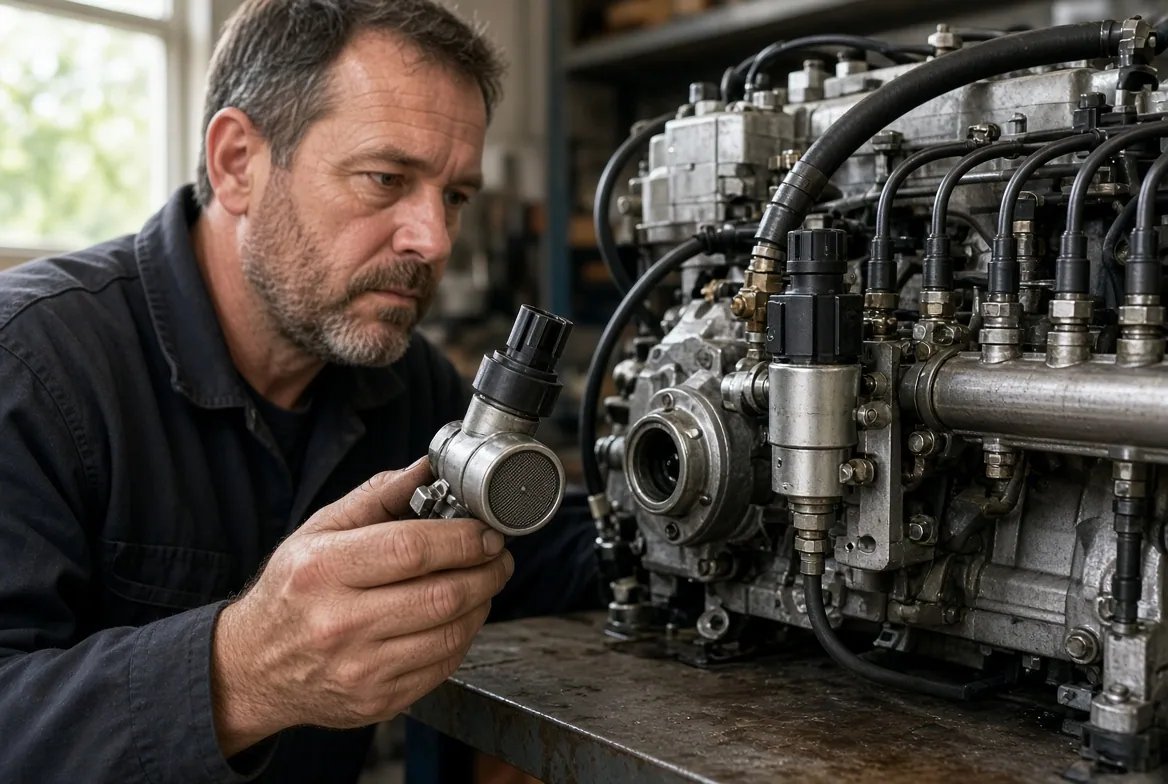
On a common-rail diesel, the part most people call the “fuel pressure regulator” is usually an inlet metering valve. It doesn’t regulate pressure directly. It controls how much fuel is allowed into the high-pressure pump, and pressure in the rail follows from that. Some systems also use a true pressure-control valve, which bleeds fuel out of the high-pressure side to bring pressure down. Many use both.
Knowing which one your engine has makes rail pressure codes far easier to diagnose.
One idea, many names
Every manufacturer has its own name for the metering valve.
| Name you may see | Typical meaning |
|---|---|
| FCA (fuel control actuator) | Cummins term for the inlet metering valve on its common-rail pumps |
| MPROP, ZME | Bosch inlet metering unit |
| SCV (suction control valve) | Denso inlet metering valve, used on HP3 and HP4 pumps |
| IMV (inlet metering valve) | Common Delphi term |
| VCV (volume control valve) | Used by Ford for its metering valve |
| FPR (fuel pressure regulator) | GM and others, usually meaning the inlet metering valve; not to be confused with the FRP, or fuel rail pressure, sensor |
| PCV (pressure control valve) | An outlet-side valve that bleeds off rail pressure |
The names differ, but the jobs are the same: meter fuel in, or bleed pressure out.
How the inlet metering valve controls pressure
The engine computer compares desired rail pressure with actual pressure from the rail sensor. To raise pressure, it opens the metering valve further so the pump compresses more fuel. To lower pressure, it closes the valve. Metering on the inlet side is efficient because the pump only works on the fuel that’s needed.
Depending on the design, the valve may be normally open or normally closed when unpowered, which affects how the engine behaves when the valve or its circuit fails.
How a pressure-control valve differs
A pressure-control valve on the high-pressure side opens to release fuel back to the return, dropping rail pressure quickly. It gives the computer fast control during rapid changes, such as sudden deceleration. Separate from both is the pressure-limiting or relief valve, a mechanical safety valve that opens if pressure exceeds a set maximum.
Symptoms of a metering or control valve problem
- Rail pressure that won’t follow the desired value, or oscillates around it
- Surging, hunting or hesitation
- Stalling, especially on deceleration or when coming to a stop
- Hard starting
- Codes for rail pressure too low (P0087) or too high (P0088)
- Fuel volume regulator circuit codes, such as P0001 through P0004
- Metering-control codes, such as P0251, on some engines
What makes these valves fail
Debris and varnish. The valve’s spool has tight clearances. Fine particles or fuel deposits make it stick or respond slowly.
Electrical faults. Open or shorted coils, corroded connectors and damaged wiring cause erratic control and circuit codes.
Wear. Over time, internal wear can affect how accurately the valve meters.
Upstream damage. If debris from a failing pump has reached the valve, the valve is a symptom of a larger problem. See Bosch CP4 pump failure.
Diagnosis that avoids parts-swapping
- Check the valve’s circuit for codes, resistance and connector condition.
- Log desired pressure, actual pressure and the valve’s command together. A valve commanded wide open with low actual pressure points toward supply problems, pump wear, injector leakage or a valve that’s mechanically stuck despite a correct command.
- Verify supply pressure and look for air.
- Check injector return flow where possible.
- If debris is found in the valve, inspect the filter and pump before replacing the valve alone.
Some metering valves are serviced separately from the pump. Others are serviced only as part of the pump assembly.
Manufacturer reference: Bosch Mobility: common-rail system overview For procedures and specifications, use the current manufacturer information for your engine and model year.
Low rail pressure codes?
Our guide to P0087 low fuel rail pressure walks through the diagnosis from start to finish. If the evidence points to the pump or its metering valve, Diesel Control Technicians can test the pump, repair what’s repairable and calibrate it. DCT can provide receiving instructions for an accepted pump. Alternatively, ask Hutchinson whether an appropriate vehicle-side diagnostic appointment is available.
Where Diesel Fuel Pressure Regulator vs Metering Valve leads next: Confirm the actual pump or component family before replacing parts. Record the engine application, existing tests and symptoms, then review the testing process or request a component review. DCT confirms service eligibility and receiving instructions individually.
QUESTIONS ABOUT YOUR DIESEL COMPONENT?
Questions about diesel Fuel Pressure Regulator vs Metering Valve?
Tell us about the engine, symptoms and checks you’ve already completed. Our specialists can help you decide what to do next.