
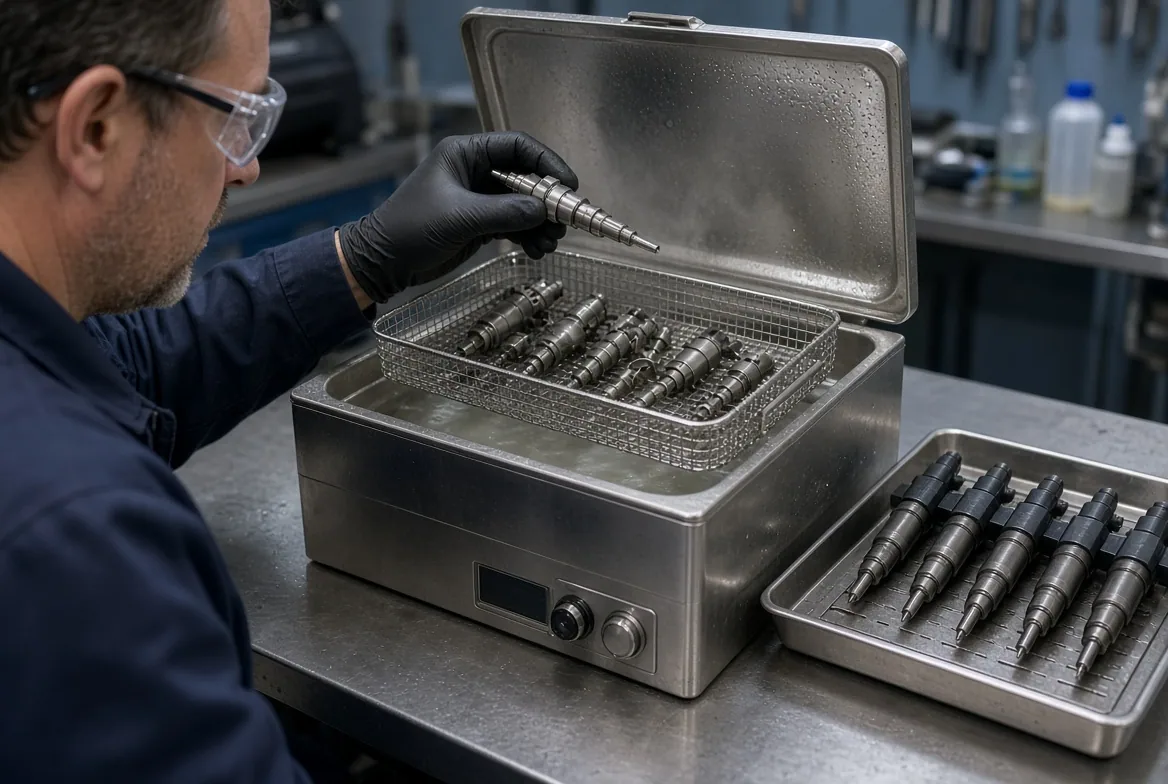
Professional injector cleaning removes deposits. That’s both its value and its limit. If removable deposits are the actual cause, an approved cleaning process may restore a supported function, which needs verification afterward. If the problem is wear, erosion, corrosion, cracking or a failed solenoid or piezo stack, cleaning won’t fix it, and an injector that “felt better” after cleaning may simply have been the wrong diagnosis.
So the useful question isn’t “should I have my injectors cleaned?” It’s “are deposits the problem?” Testing before and after cleaning is the only reliable way to know.
Two very different kinds of cleaning
On-engine fuel system cleaning runs a cleaning solution through the fuel system while the engine idles. It can loosen light deposits, but nobody can measure the result on individual injectors, and it does nothing for wear. Bottled additives are a third option with their own limits; see do diesel injector cleaners work?
Off-vehicle injector cleaning happens on the bench with the injectors removed. The injector’s exterior and nozzle area are cleaned, internal passages may be flushed, and the injector is tested to see whether its delivery, return flow and spray behavior returned to specification. This is the kind of cleaning that produces evidence, and the kind this article is about.
The deposits cleaning can address
Carbon at the nozzle tip. Combustion byproducts can build up around and inside the nozzle holes, disrupting the spray. Mild to moderate tip coking often responds well to cleaning.
Varnish and lacquer. Fuel degradation and some additive interactions can leave sticky films on moving parts. Sometimes cleaning frees a control valve or needle that was responding sluggishly.
Internal injector deposits. The fuel industry has documented a category of deposits that form inside modern high-pressure injectors, including soap-like and lacquer-like residues. They can cause sticking and erratic delivery. Cleaning helps in some cases. In others the deposits are too stubborn, or the sticking has already caused wear.
What cleaning can’t fix
- Worn needle seats and guides, which cause dribbling and leakage
- Eroded or enlarged nozzle holes, which over-fuel and distort the spray
- Worn control valves, the usual cause of high return flow on common-rail injectors
- Electrical failure of a solenoid coil or piezo stack
- Corrosion pitting from water in the fuel
- Cracked bodies or damaged sealing surfaces
- Debris damage from a failing high-pressure pump
These failures account for a large share of injectors that come off high-mileage engines, which is why cleaning alone is rarely a complete answer for an injector that has actually failed.
Where cleaning makes the most sense
- Moderate-mileage injectors with symptoms that point to deposits, such as gradually worsening smoke or a slightly uneven idle, rather than a sudden failure
- Injectors that test marginal on the bench, especially at low-delivery points such as idle and pilot, and have no sign of mechanical wear
- Mechanical nozzles from older engines, where carbon removal and resetting opening pressure can restore a good spray (see our guide to the diesel injector pop test)
- Equipment that has sat for long periods with degraded fuel, such as standby generators and seasonal machinery
Where it doesn’t
- Injectors with high return flow, which is a wear problem
- Injectors from an engine that had water, gasoline, DEF or metal debris in the fuel
- Injectors with an electrical fault code
- An engine where nobody has confirmed the injectors are the problem
Clean, then measure
A cleaned injector should be tested afterward against the same test plan as any other injector. If it passes, the cleaning worked and you’ve avoided a replacement. If it doesn’t, you have a clear answer about what comes next: repair, a remanufactured unit or new. For help weighing those, see remanufactured vs rebuilt vs new diesel injectors.
Skip the test and you’re paying for a hopeful outcome rather than a confirmed one.
Manufacturer reference: Bosch Aftermarket: diesel test benches and tools For procedures and specifications, use the current manufacturer information for your engine and model year.
Ask DCT whether cleaning fits your injectors
Diesel Control Technicians offers injector cleaning alongside testing, repair, rebuilding and remanufacturing, so the recommendation can follow what the injectors actually show. After DCT confirms eligibility and provides written receiving instructions, mail in the approved set with a description of the symptoms, or request approved component receiving at the DCT-designated Hutchinson or Great Bend location, and ask for testing before anything else.
QUESTIONS ABOUT YOUR DIESEL COMPONENT?
Questions about diesel Injector Cleaning?
Send us the injector number, engine model and relevant test results. We’ll help you explore the service options for your exact component.