
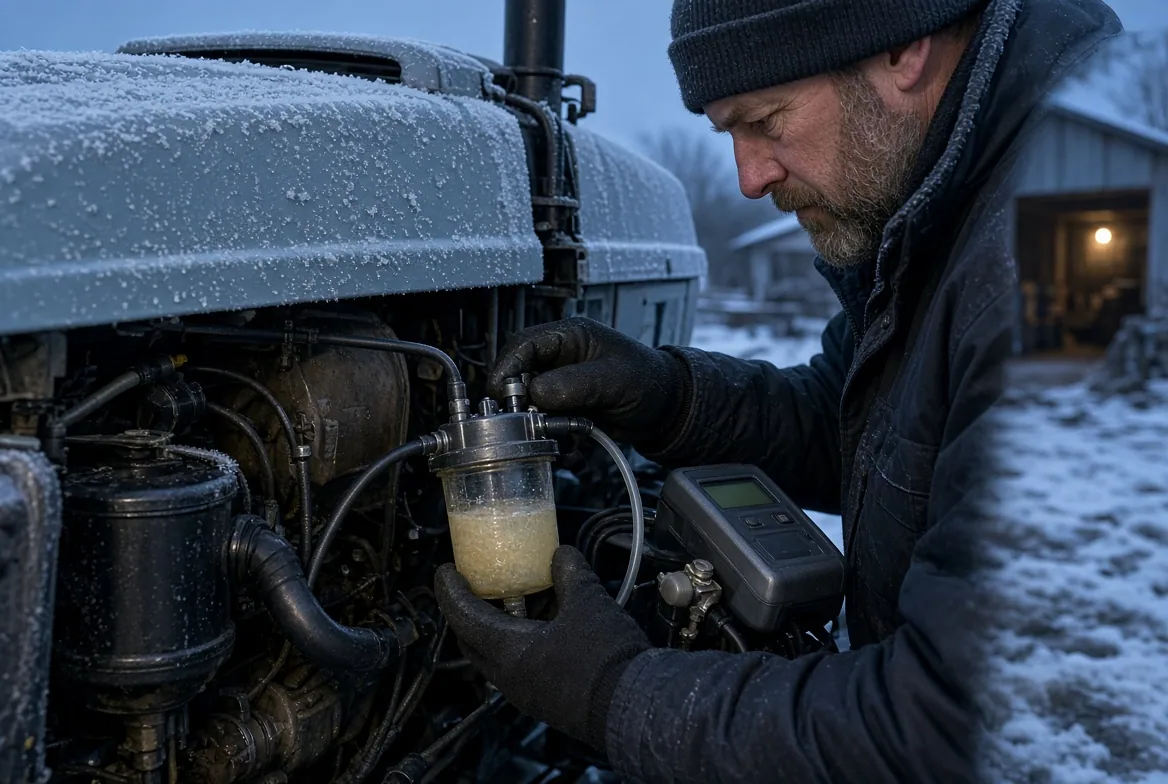
Cold weather attacks a diesel’s ability to start from three directions at once. It turns fuel waxy until crystals plug the filter, it leaves glow plugs or an intake grid heater with no margin if they’re weak, and it slows the starter by thickening the oil and draining battery capacity. Fuel injection faults can be involved, but they’re further down the list. Rule out the big three first.
How diesel fuel behaves in the cold
Diesel fuel contains paraffin wax that stays dissolved when it’s warm. As temperature drops, the wax begins to form crystals. The temperature where the fuel first turns hazy is its cloud point. A little colder, wax crystals are large enough to plug a fuel filter; that’s the cold filter plugging point. Colder still, the fuel can gel.
Number 2 diesel is the most vulnerable. Number 1 diesel, which is closer to kerosene, has far better cold properties, and winter blends mix the two or use additives. Fuel bought in a warm region and driven north, or summer fuel still in a farm tank in December, is a common trap.
Signs the fuel is the problem
- The engine cranks at normal speed but won’t fire, or starts and dies
- It ran fine yesterday and stopped after a hard overnight freeze
- Fuel in the filter or a clear line looks cloudy or waxy
- The engine starts after the filter housing is warmed
- Other equipment fueled from the same tank has the same problem
Water in the fuel can freeze into ice in the filter or water separator, with the same result. Draining the separator regularly matters more in winter. See water in diesel fuel.
Signs the cold-start aids are the problem
- Cranks fine, lots of white smoke, and slow or no start
- Some cylinders fire and the engine runs rough, then smooths out
- The glow plug or wait-to-start light behaves differently than usual
- Codes for glow plug circuits or the intake heater
Glow plugs heat the combustion chamber. Intake grid heaters, used on engines such as the Cummins B-series, heat the incoming air. Either one failing leaves the engine without enough heat to ignite fuel.
Signs cranking speed is the problem
- The engine turns over slowly or labors
- Battery voltage drops sharply when cranking
- A block heater wasn’t used, and the oil is thick
Cold batteries lose much of their capacity, and cold oil makes the engine harder to turn. A diesel needs enough cranking speed to create compression heat. On engines whose injectors depend on electrical supply or oil, slow cranking compounds the problem: the 6.0 Power Stroke’s fuel injection control module (FICM) needs adequate battery voltage, and HEUI injectors fire with engine oil that’s sluggish when cold.
Getting it started
- Check battery state and cranking speed. Charge or replace weak batteries, and clean connections.
- Use the block heater if equipped. A warm engine starts much more easily.
- Let the glow or heater cycle complete before cranking. Repeat once if needed.
- Inspect the fuel filter. If it’s waxed, replace it and warm the housing and lines if you can do so safely.
- Treat gelled fuel with a product intended to restore gelled fuel, following its directions. Ordinary anti-gel additives work best when added before the cold arrives.
- Switch to winter blend or No. 1 diesel in the tank once you’re running.
Cold-weather mistakes to avoid
- Don’t use starting fluid on engines with glow plugs or an intake grid heater. Ether ignited by a hot heater or glow plug can cause severe engine damage. Many engine makers prohibit it.
- Don’t add gasoline to thin diesel. Gasoline lacks lubricity and can damage modern injection pumps and injectors. See gasoline in a diesel tank.
- Don’t use an open flame to warm fuel lines or filters.
- Don’t crank endlessly. Let the starter cool between attempts.
When it’s not the cold
If the batteries are strong, the glow system works and the fuel is clear, but the engine still won’t start in the cold, the injection system becomes a suspect. Some injection problems are worse cold, such as sticking injectors on HEUI engines or a mechanical pump with a cold-advance fault. Others are worse hot; see diesel hard to start when hot. A general no-start checklist is in diesel cranks but won’t start.
Manufacturer reference: Bosch Mobility: common-rail system overview For procedures and specifications, use the current manufacturer information for your engine and model year.
Winter help from central Kansas
Kansas winters find every weak fuel system. If your truck, tractor or equipment has a cold-start problem that isn’t gel, glow or batteries, Diesel Control Technicians can discuss appropriate vehicle-side diagnostics through Hutchinson by confirmed appointment, or test injectors and pumps shipped from anywhere.
Where Diesel Won’t Start in Cold Weather leads next: Confirm the actual pump or component family before replacing parts. Record the engine application, existing tests and symptoms, then review the testing process or request a component review. DCT confirms service eligibility and receiving instructions individually.
QUESTIONS ABOUT YOUR DIESEL COMPONENT?
Need guidance on Diesel Won’t Start in Cold Weather? Gel, Glow or Injection?
Cold-start problems can involve fuel gelling, cranking speed, starting aids or injection performance. Learn which conditions distinguish a winter fuel problem from an underlying component fault. Include the exact component number, equipment application, symptoms and checks already completed.