
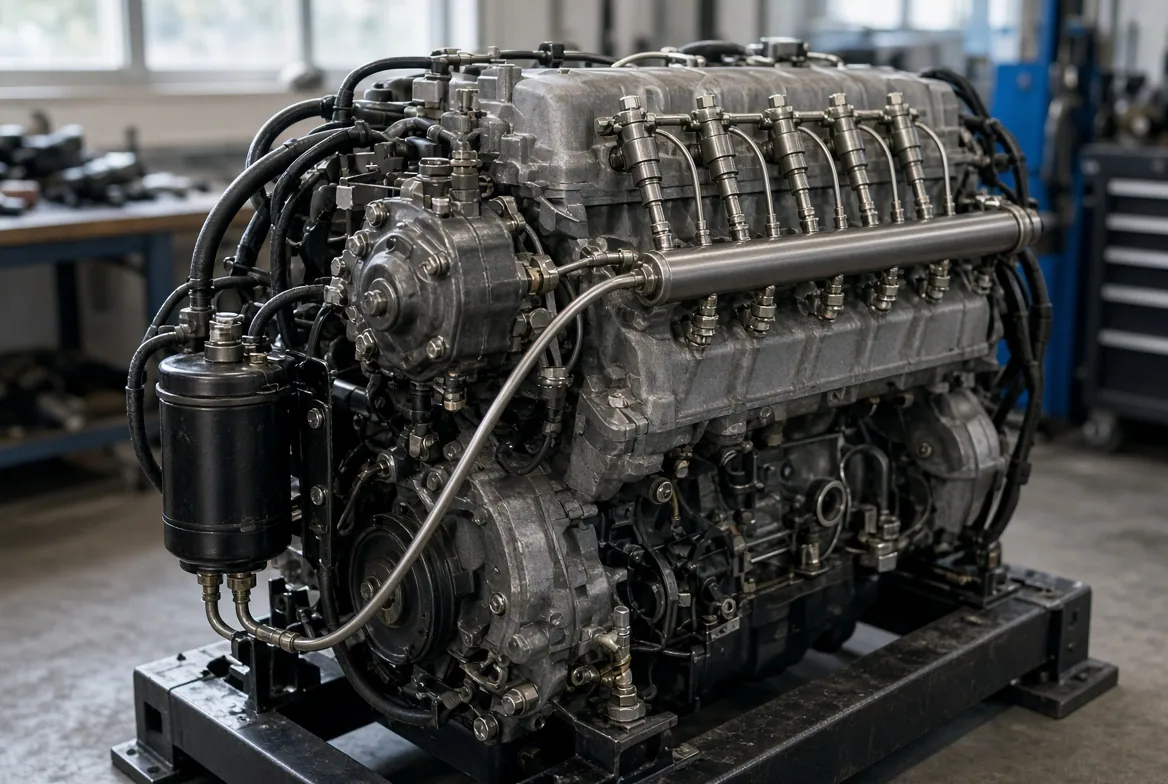
A common-rail system separates two jobs that older diesels combined. A high-pressure pump keeps a shared fuel rail charged to very high pressure, with maximums of roughly 20,000 to more than 30,000 psi depending on the engine, and much less at idle. The injectors, controlled by the engine computer, open and close to release that pressurized fuel into each cylinder, as many times per combustion cycle as the calibration calls for.
Think of the rail as an air tank on a compressor. The pump keeps the tank full, and the injectors are fast valves that decide exactly when and how long to let it out.
Here’s the path fuel takes, and what each part does.
1. The tank and the low-pressure supply
Fuel starts in the tank, drawn by a lift or transfer pump. Depending on the engine, that pump may be in the tank, on the frame or built into the high-pressure pump. Its job is to deliver fuel to the high-pressure pump at the right pressure, without air.
This part of the system gets ignored until it causes trouble. A weak lift pump or an air leak on the suction side can starve the high-pressure pump and produce symptoms that look like major failures. See lift pump failure symptoms.
2. Filtration and water separation
Before fuel reaches the high-pressure pump, it passes through one or more filters and a water separator. Modern common-rail filters trap very fine particles because the components downstream have clearances measured in microns. Water is drained from the separator, which is why a water-in-fuel warning light should never be ignored.
3. The high-pressure pump
The high-pressure pump, such as a Bosch CP3 or CP4 or a Denso HP3 or HP4, uses one or more plungers driven by a cam to squeeze fuel to rail pressure. On most systems, an inlet metering valve controls how much fuel enters the pumping chambers, which is how the computer controls rail pressure. Some systems also use a pressure-control valve at the rail or pump.
The pump is lubricated by the fuel passing through it, so fuel quality matters a great deal.
4. The rail
The rail is a thick-walled steel tube or block that stores fuel at pressure and feeds every injector. It carries a pressure sensor, which reports actual pressure to the computer, and often a pressure-limiting or relief valve that opens if pressure exceeds a safe level. The stored volume damps pressure pulses so every injector sees steady pressure.
5. The injectors
Each injector is connected to the rail by a steel high-pressure line, or on some engines a connector tube through the cylinder head. Inside, pressure acts on both ends of the injector’s needle. When the computer energizes the injector’s solenoid or piezo actuator, a small control valve opens and releases pressure from one end, the needle lifts, and fuel sprays through nozzle holes into the cylinder. When the actuator switches off, the needle closes.
That control fuel has to go somewhere, so a small amount returns to the tank through the return line. Measuring it is one of the best ways to find worn injectors. For the difference between actuator types, see solenoid vs piezo injectors.
6. The return path
Return fuel from the injectors, and on many systems excess fuel from the pump, flows back to the tank. Some systems pass it through a cooler first, because compressing fuel to extreme pressure heats it.
7. The computer in charge
The engine computer reads crankshaft and camshaft position, accelerator position, boost, temperatures and rail pressure. From those inputs it decides the desired rail pressure and the injection pattern for every cylinder on every cycle: when to inject, how long, and how many times.
That’s where common rail shines. Because pressure is available at any engine speed, the computer can split injection into events:
- Pilot injections: small early shots that soften combustion noise
- The main injection: the power stroke
- Post injections: on some engines, used for emissions control or exhaust-filter regeneration
The result is a diesel that’s quieter, cleaner and more powerful than the mechanical systems it replaced.
Why common rail is so sensitive
Extreme pressure, tiny clearances and fuel-lubricated parts mean common-rail systems tolerate very little water, dirt or air. A contaminant that an old mechanical pump might shrug off can damage a common-rail injector or pump. That’s why the failures that get the most attention, such as Bosch CP4 pump failure, are so often linked to water, air or poor lubricity reaching parts with little margin for them.
A safety reminder
Rail pressure can remain high after shutdown. Do not loosen or probe high-pressure connections while the system may be pressurized, and do not search for live leaks with hands or makeshift materials. A trained technician should use the engine maker’s isolation, inspection and depressurization procedure. Fuel injection through the skin is a medical emergency.
Manufacturer reference: Bosch Mobility: common-rail system overview For procedures and specifications, use the current manufacturer information for your engine and model year.
When the system needs a specialist
Diesel Control Technicians tests, repairs and calibrates common-rail pumps and injectors for pickups, heavy trucks and equipment. If your engine is showing low rail pressure, hard starting or a cylinder out of balance, request a confirmed on-vehicle service request in Hutchinson, subject to prior confirmation, or mail approved components to DCT following written receiving instructions for supported bench testing.
Where How Common-Rail Diesel Injection Works, Step by Step leads next: Confirm the actual pump or component family before replacing parts. Record the engine application, existing tests and symptoms, then review the testing process or request a component review. DCT confirms service eligibility and receiving instructions individually.
QUESTIONS ABOUT YOUR DIESEL COMPONENT?
Need guidance on How Common-Rail Diesel Injection Works, Step by Step?
A common-rail system separates fuel pressurization from electronically timed injection events. Follow the major components and their roles so pressure faults and injector faults are not confused. Include the original high-pressure pump or injector number, engine identification and any measured supply or rail-pressure results.