
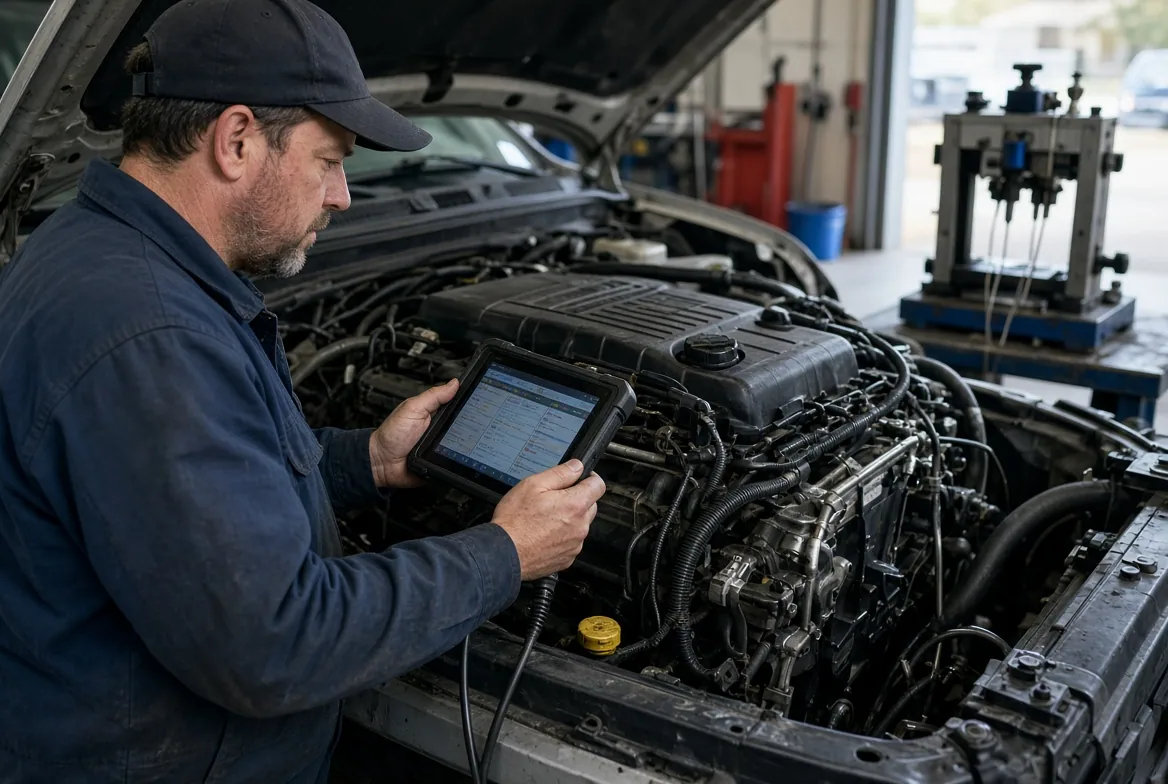
The two tests answer different questions. On-vehicle testing answers “what is this engine’s fuel system doing, and which part is responsible?” Bench testing answers “how well does this specific injector or pump perform against its specification?”
If you don’t yet know which component is at fault, start on the vehicle. If you’ve already identified the component, or it has already been removed, the bench gives you a measured verdict. The most reliable repairs use both, in that order.
What on-vehicle testing can show
On-vehicle testing looks at the whole system in its real environment: real fuel, real temperatures, real wiring and the engine’s own controls. Depending on the system, it can include:
- Scan-tool data: desired versus actual rail pressure, injector balance or contribution values, fuel corrections, and codes with their freeze-frame conditions
- Cylinder cutout or contribution tests to find a cylinder that isn’t pulling its weight
- Injector return-flow measurement on engines where the manufacturer publishes an on-engine procedure
- Supply-side checks: lift pump pressure, suction restriction, filter condition and a clear-line check for air
- A fuel sample to look for water, debris, gelling or contamination
- HEUI oil-side checks: injection control pressure, regulator duty cycle, and injector buzz tests
- Mechanical-system checks: pump timing, governor response and smoke behavior
The big strength: on-vehicle testing finds problems that aren’t in the injectors or pump at all. Air leaks, a weak lift pump, chafed wiring and a stuck pressure-relief valve all show up here. None of them would show up on a bench.
What on-vehicle testing can’t show
It can’t measure precisely how much fuel one injector delivers at a given pressure and pulse, or whether its pilot injection is in tolerance. It can show that cylinder four is the outlier, but it usually can’t say why. It also can’t evaluate a component that’s too far gone to run the engine.
What bench testing can show
Off the engine, a compatible test bench applies the supported sequence for the specific injector or pump. Depending on design and equipment, it may assess delivery, leakage, return flow, timing, response or calibration. The report should make test limits and untested functions explicit. Our guides to injector bench testing and injection pump calibration explain the measurements. Bench results tell you whether a part is good, marginal or failed, and often how it failed.
Which to start with
| Your situation | Start here | Why |
|---|---|---|
| Engine runs, cause unknown | On-vehicle | Find the system at fault before removing parts |
| Codes or data point to one cylinder | On-vehicle, then bench | Confirm the cylinder, then measure the injector |
| Engine won’t run, pump suspected | On-vehicle supply checks, then bench | Rule out fuel supply before pulling the pump |
| Parts already removed | Bench | The component is in hand |
| Fuel contamination event | Inspection and fuel sample, then bench | Learn what got in before deciding what to save |
| Symptom returned after a repair | On-vehicle | Look for the cause the first repair missed |
Why it helps to have both under one roof
When the same shop performs both kinds of tests, the evidence connects. A technician who saw cylinder three’s balance rate on the scan tool knows what to look for when injector three goes on the bench. A pump that tests perfectly after a vehicle showed low rail pressure points straight back to the engine side: injector return, the relief valve or the fuel supply.
When the tests happen in different places, that context gets lost unless someone writes it down. If your local shop does the on-vehicle work and ships parts to a specialist, send the scan data, test readings and symptom description with the parts.
Manufacturer reference: Bosch Aftermarket: diesel test benches and tools For procedures and specifications, use the current manufacturer information for your engine and model year.
Test where it makes sense for you
Diesel Control Technicians performs both on-vehicle and off-vehicle testing. Customers in and around central Kansas can contact Hutchinson to ask whether the specific vehicle and diagnostic request are eligible for a confirmed appointment, so the engine can be checked before anything comes apart. Customers elsewhere can have their local shop handle the on-engine checks and mail approved components to DCT following written receiving instructions for supported bench testing, ideally with the data that led them there.
Where On-Vehicle vs Bench Fuel Injection Testing leads next: Confirm the actual pump or component family before replacing parts. Record the engine application, existing tests and symptoms, then review the testing process or request a component review. DCT confirms service eligibility and receiving instructions individually.
QUESTIONS ABOUT YOUR DIESEL COMPONENT?
Questions about on-Vehicle vs Bench Fuel Injection Testing?
Tell us about the engine, symptoms and checks you’ve already completed. Our specialists can help you decide what to do next.