
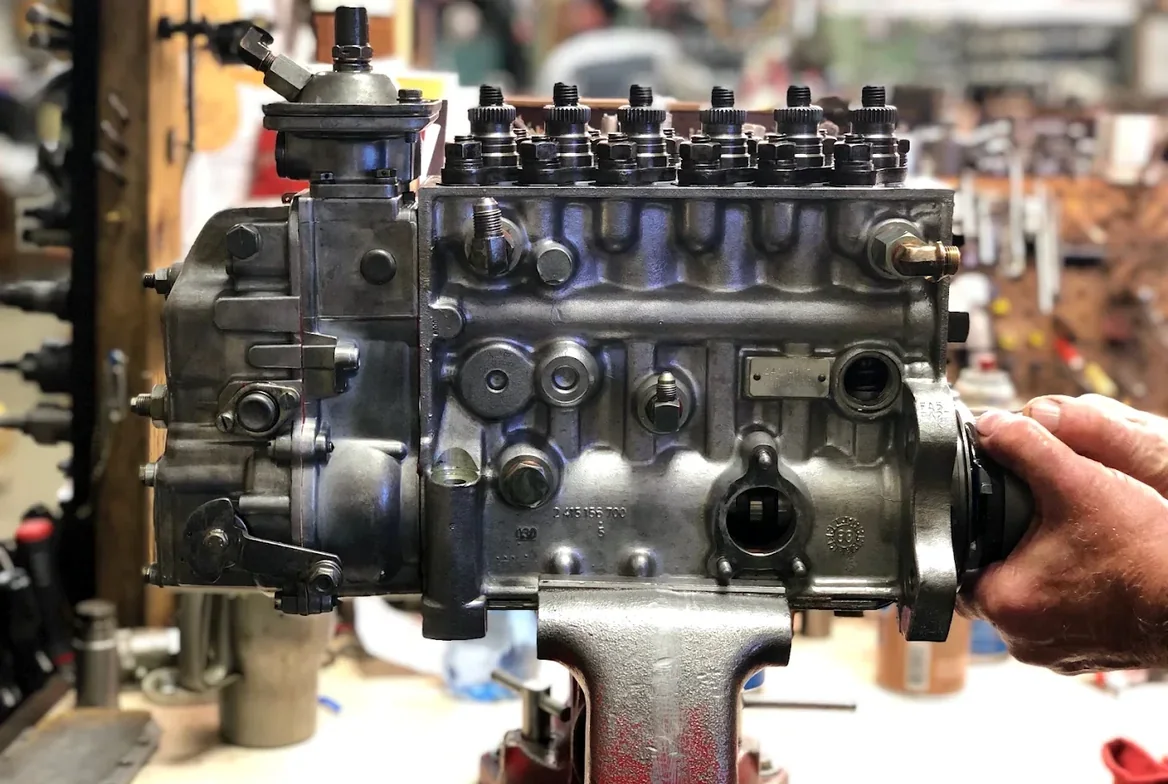
The Stanadyne DB2 is a mechanical rotary injection pump that fed an enormous range of diesels: GM 6.2 engines and early and naturally aspirated 6.5s, military HMMWVs with the 6.2 and 6.5, Ford’s 6.9 and 7.3 IDI trucks, and a long list of John Deere, industrial and generator engines. It’s simple, compact and durable. Its typical problems are hard starting when hot from internal wear, leaks at the throttle shaft and covers, timing advance faults, shutoff solenoid failures and governor wear. All are fixable, and the pump is very much rebuildable.
How a DB2 works
Inside the DB2, a vane-type transfer pump draws fuel from the supply and pressurizes it slightly. A rotating rotor inside a stationary hydraulic head carries a pair of opposed pumping plungers. As the rotor turns, an internal cam ring pushes the plungers inward via rollers and shoes, pressurizing fuel, and the rotor’s distributor passage routes each charge to the correct outlet and injector line in turn.
A metering valve, positioned by a mechanical governor, controls how much fuel enters the plungers each cycle. An automatic advance mechanism, driven by transfer pump pressure, rotates the cam ring to change injection timing with speed. An electric shutoff solenoid on many versions cuts fuel when the key is turned off.
The whole pump is lubricated and cooled by the fuel passing through it.
How DB2 pumps wear out
Hard starting when hot. Fuel thins as it heats, and wear in the rotor, head and plungers lets more of it leak internally. A DB2 that starts cold and cranks hot is a classic wear complaint. See diesel hard to start when hot.
Leaks. Throttle shaft seals and top cover gaskets are common seep points as the pump ages. A leak that weeps fuel can also draw air in under some conditions, causing rough running and hard starts.
Timing advance problems. A sticking advance piston leaves timing retarded or advanced. Retarded timing brings white smoke, poor power and hard starting. Excessive advance brings noise and harsh running.
Shutoff solenoid failure. A failed solenoid causes a no-start, or occasionally an engine that won’t shut off with the key. It’s a simple check that’s often overlooked.
Governor wear. Worn governor weights, pivots and linkage cause surging, poor idle control and failure to reach governed speed. See diesel surging at idle.
Transfer pump wear. Worn vanes or liner reduce internal pressure, affecting delivery and advance.
Fuel lubricity and older DB2 pumps
DB2 pumps were designed long before ultra-low sulfur diesel became the standard. Many owners of older pumps pay close attention to fuel lubricity and filtration. See ULSD lubricity and older injection pumps.
Rule these out first
- Check fuel supply, filters and the lift pump.
- Look for air in the fuel.
- Confirm the shutoff solenoid works.
- On IDI engines, check glow plugs and the glow controller for cold-start complaints.
- Check timing marks and confirm the pump hasn’t been rotated.
- Consider the nozzles: worn or leaking nozzles cause smoke and rough running too.
What a DB2 rebuild includes
A proper rebuild involves complete disassembly, cleaning and inspection; replacement of seals, gaskets and worn parts, which may include the hydraulic head and rotor, cam ring, rollers and shoes, transfer pump components and governor parts; reassembly; and calibration on a test stand. Calibration verifies delivery at key speeds, governor cut-off, advance behavior, transfer pump pressure and outlet balance. See what happens in an injection pump rebuild.
Matched hydraulic parts are replaced as matched sets. The tag information on the pump defines the calibration it should be set to, so record it before the pump comes off. See injection pump identification.
DB2 or DB4?
The DB4 is a larger relative of the DB2 used on bigger engines and higher fuel demands, including some John Deere applications. The two share design principles but not all parts or calibrations. GM’s electronically controlled 6.5 turbo diesels moved to the DS4 starting in 1994; see GM 6.5 diesel DS4 injection pump.
Manufacturer reference: Bosch: Diesel Repair Network and supported component service For procedures and specifications, use the current manufacturer information for your engine and model year.
Send your DB2 to DCT
Diesel Control Technicians tests, rebuilds and calibrates injection pumps for pickups, tractors, generators, industrial engines and military vehicles. Send us a clear photo of your DB2’s tag and a description of the symptoms to confirm the options for it. Local customers can confirm a Hutchinson automotive appointment or approved component receiving at the location DCT assigns; everyone else can ship the accepted pump to DCT using written receiving instructions.
Where Stanadyne DB2 Injection Pump leads next: Confirm the actual pump or component family before replacing parts. Record the engine application, existing tests and symptoms, then review the testing process or request a component review. DCT confirms service eligibility and receiving instructions individually.
QUESTIONS ABOUT YOUR DIESEL COMPONENT?
Questions about stanadyne DB2 Injection Pump?
Send us the pump number, engine information and symptoms. We’ll help you understand the next steps for your exact component.