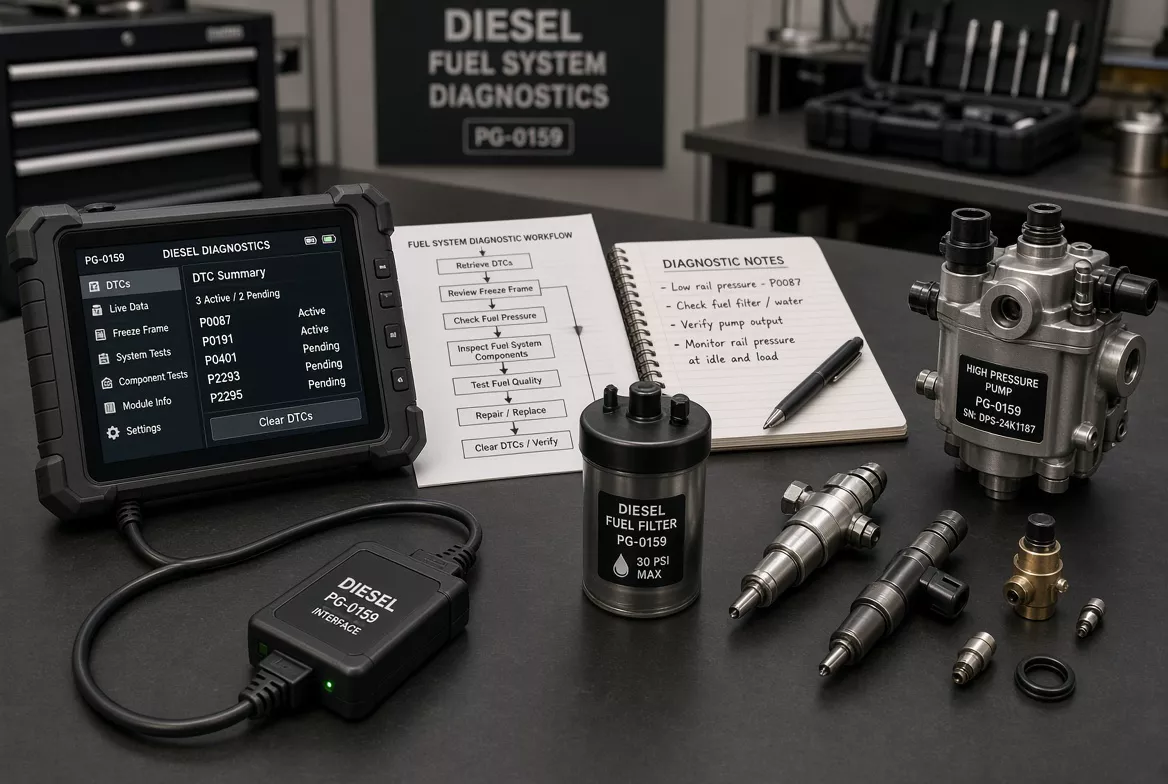
The controller on a common-rail engine behaves rather like a skilled operator constantly adjusting a valve to meet a pressure target. Under normal conditions it can correct small differences between demand and reality. But every control strategy has limits. P016D, P016E, P016F and P228A–P228F describe situations in which closed-loop regulation takes too long, reaches a pressure-control boundary, crosses an adaptive limit, or triggers protective action on supported vehicles.
Look up the exact meaning of 8 codes covered below
What closed-loop control really means
In closed-loop operation, the controller uses feedback—typically rail pressure—to modify the command sent to metering or regulating hardware. P016D relates to excessive time needed to establish closed-loop regulation. P016E and P016F concern high and low control-limit behavior. P228C/P228D describe control limits involving regulator 1, while P228E/P228F relate to learned limits. P228A can indicate a forced shutdown associated with regulator control. The detailed thresholds and control arrangements vary by engine.
A limit is evidence of a struggle, not a parts diagnosis
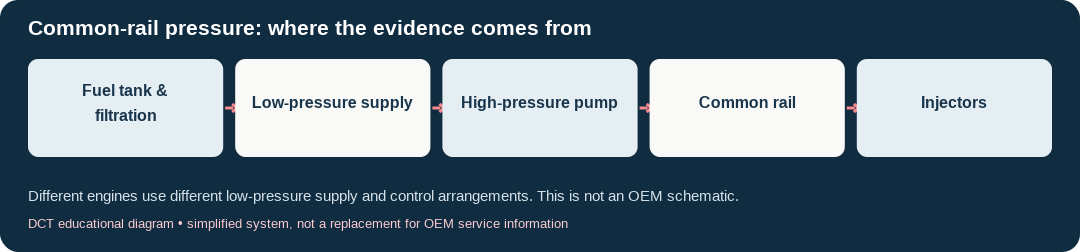
An engine struggling to reach pressure may command more fuel through a valve until the strategy runs out of correction. The valve may be responding correctly to a problem caused by low-side supply, an internal leak or a pump that cannot deliver. In another case, an electrically faulty valve or inaccurate sensor may be the source. Diagnosing a control-limit DTC without checking requested and actual pressure plus the relevant command is like judging a thermostat without knowing the actual room temperature.
How a good diagnosis progresses
First identify the fault’s operating conditions and any P0087, P0088, P0191, supply or injector codes. Confirm pressure feedback and electrical supply, compare demand with control response, then evaluate low-side fuel availability and application-specific high-pressure leakage or delivery. The correct order may be modified by OEM diagnostic routines or service bulletins. If a forced-shutdown code is present, avoid repeated operation until the condition has been assessed.
This group connects directly to P0087, P0088, P0089 and the rail pressure hub. Contact our diesel injection team if the evidence points toward pump or injector component evaluation.
Frequently asked questions
Does P228C mean the regulator itself failed?
Not necessarily. The controller may have reached a limit because another part of the system cannot sustain pressure.
Can sensor faults create closed-loop control-limit codes?
Yes. Incorrect pressure feedback can distort control response, which is why plausibility is checked before concluding that hydraulic hardware is defective.
Keep exploring the right evidence
Learn what diesel fuel pressure controller limits and learning codes mean, how they relate to rail pressure, and why feedback matters. Include the exact part and controller number, engine application, fault history and verified electrical or connector findings.
Find your exact trouble code in this group
Compare requested and measured pressure in the conditions that set the code; distinguish pressure generation, supply, leakage, sensing and control. The individual descriptions below identify which monitor needs attention; the full guide explains the associated system.
| DTC | Monitored condition | Diagnostic distinction |
|---|---|---|
| P016D | Excessive time to enter closed-loop fuel pressure control | Controller took too long to establish stable pressure regulation. |
| P016E | Closed-loop fuel pressure control at high limit | Controller reaches a high-pressure control boundary; not automatic proof of a failed regulator. |
| P016F | Closed-loop fuel pressure control at low limit | Controller reaches a pressure-related limit; investigate why sufficient pressure cannot be sustained. |
| P228A | Fuel pressure regulator 1 forced engine shutdown | Protective shutdown fault; identify why regulation became unacceptable. |
| P228C | Fuel pressure regulator 1 exceeded control limits—pressure low | Pressure control reached its available correction; evaluate supply and leakage before replacement. |
| P228D | Fuel pressure regulator 1 exceeded control limits—pressure high | Pressure high-limit behavior can involve control, feedback, or metering issues. |
| P228E | Fuel pressure regulator 1 learning limits too low | Adaptive control low limit; context matters more than regulator name. |
| P228F | Fuel pressure regulator 1 learning limits too high | Adaptive control high limit; check pressure strategy and related codes. |
The code descriptions are general. Confirm the exact definition, engine application and OEM diagnostic procedure before relying on a component conclusion. High-pressure diesel fuel is hazardous; do not loosen live common-rail connections.