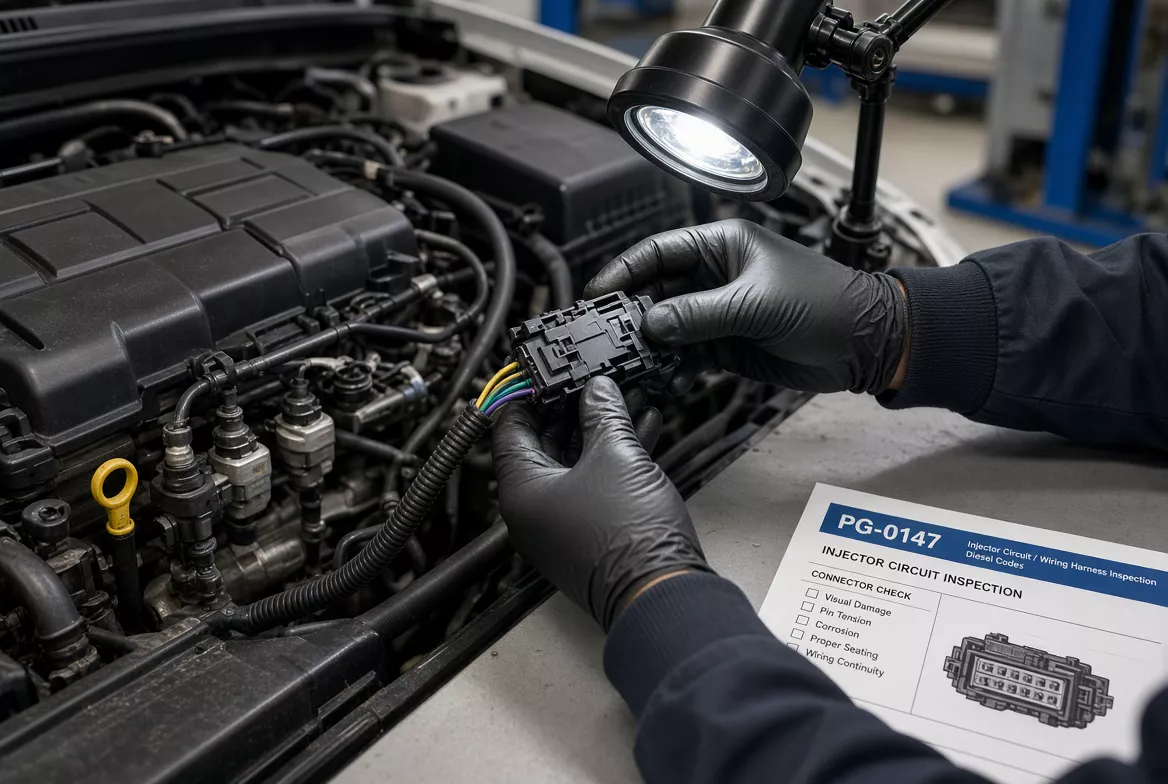
A diesel engine is exceptionally good at announcing an uneven combustion event: the idle changes, the cab shakes, and power delivery may turn rough enough to make every hill feel steeper. The scan tool might report P0300, random or multiple-cylinder misfire, or P0301 through P0308, identifying a detected misfire pattern associated with a particular cylinder. For anyone who works with injection equipment, that immediately raises a fair question: is an injector failing? The less satisfying, more useful answer is that an injector is a candidate, not a verdict.
Look up the exact meaning of 9 codes covered below
What a diesel misfire monitor can see
A controller commonly infers combustion quality from changes in crankshaft speed or other application-specific signals. It can detect that the engine is not running as expected without independently measuring every droplet entering the cylinder. On an eight-cylinder engine, P0304 points toward cylinder 4 as the monitored contributor; on a different configuration, the cylinders monitored and available codes vary. P0300 indicates a more general misfire pattern rather than supplying a neat cylinder address. Confirm the monitor strategy for the particular make and model before treating the code as a precise account of which physical component has failed.
What else can cause the same symptom?
A diesel injector that cannot deliver the intended fuel quantity, sprays poorly, leaks, or fails electrically may create a rough combustion event. But the same cylinder can suffer from low compression, a valve or sealing problem, air-handling imbalance, poor electrical control, timing or synchronization issues, or another mechanical fault. Multiple-cylinder symptoms make supply capacity, shared electrical paths, contaminated fuel, and engine operating conditions especially important. A related P0263-family contribution/balance fault can strengthen the case that one cylinder deserves attention, but neither code family proves that an injector is defective.
For that reason, comparing live cylinder contribution or correction information can be helpful only when the mechanic understands what the particular scan-tool value measures. A large correction may be the computer trying to compensate for a mechanical deficiency rather than proof that an injector flows the wrong amount. The diagnostic sequence may combine operating observations, a scan-tool evaluation, electrical checks, authorized injector return or functional testing, and mechanical checks such as compression or cylinder sealing where justified.
What an injector specialist can actually establish
If vehicle-level testing points toward an injector, professional evaluation may help determine its electrical condition and relevant hydraulic or spray characteristics, according to the design and the testing equipment available. The key is to connect the test results with the symptoms and the cylinder identified on the vehicle; a bench result is much more valuable when paired with valid operating data and an accurate component number.
Read the cylinder contribution and balance guide for P0263–P0284, or the rough idle, smoke and misfire guide for symptom-based diagnosis. If a qualified technician has isolated an injector for testing, contact our diesel injection team with the code, cylinder, engine, and tests already performed.
Individual cylinder misfire codes
On supported eight-cylinder engines, the cylinder-specific sequence is straightforward: P0301 means a misfire was detected for cylinder 1, P0302 for cylinder 2, P0303 for cylinder 3, and P0304 for cylinder 4. The sequence continues as P0305 for cylinder 5, P0306 for cylinder 6, P0307 for cylinder 7, and P0308 for cylinder 8. The general P0300 code describes random or multiple-cylinder misfire detection. These numbers identify which combustion events the controller judged abnormal, not a verified cause; an injector, cylinder mechanical condition, control fault, or another system can affect the result.
Frequently asked questions
Does P0300 mean all injectors are bad?
No. P0300 indicates random or multiple-cylinder misfire detection. A single common problem, such as low fuel supply or a mechanical issue, can affect more than one cylinder.
Is P0303 enough reason to replace injector 3?
No. Cylinder identification makes the diagnostic investigation more focused, but electrical, mechanical, and fueling evidence is needed before condemning injector 3.
Keep exploring the right evidence
Learn what P0300 through P0308 mean on diesel engines, why misfires can have mechanical or electrical causes and how injector testing fits the diagnosis. Include the injector or nozzle number, engine identification, relevant cylinder observations and any completed injector testing.
Find your exact trouble code in this group
Verify the affected cylinder and compare fuel-delivery evidence with compression, mechanical condition, wiring and other cylinder influences. The individual descriptions below identify which monitor needs attention; the full guide explains the associated system.
| DTC | Monitored condition | Diagnostic distinction |
|---|---|---|
| P0300 | Random/multiple-cylinder misfire | Multiple-cylinder misfire can arise from fueling, electrical, mechanical or airflow conditions. |
| P0301 | Cylinder 1 misfire detected | The misfire was reported for cylinder 1; separate fueling or injector control problems from compression, mechanical and other engine-control causes. |
| P0302 | Cylinder 2 misfire detected | The misfire was reported for cylinder 2; separate fueling or injector control problems from compression, mechanical and other engine-control causes. |
| P0303 | Cylinder 3 misfire detected | The misfire was reported for cylinder 3; separate fueling or injector control problems from compression, mechanical and other engine-control causes. |
| P0304 | Cylinder 4 misfire detected | The misfire was reported for cylinder 4; separate fueling or injector control problems from compression, mechanical and other engine-control causes. |
| P0305 | Cylinder 5 misfire detected | The misfire was reported for cylinder 5; separate fueling or injector control problems from compression, mechanical and other engine-control causes. |
| P0306 | Cylinder 6 misfire detected | The misfire was reported for cylinder 6; separate fueling or injector control problems from compression, mechanical and other engine-control causes. |
| P0307 | Cylinder 7 misfire detected | The misfire was reported for cylinder 7; separate fueling or injector control problems from compression, mechanical and other engine-control causes. |
| P0308 | Cylinder 8 misfire detected | The misfire was reported for cylinder 8; separate fueling or injector control problems from compression, mechanical and other engine-control causes. |
The code descriptions are general. Confirm the exact definition, engine application and OEM diagnostic procedure before relying on a component conclusion. High-pressure diesel fuel is hazardous; do not loosen live common-rail connections.