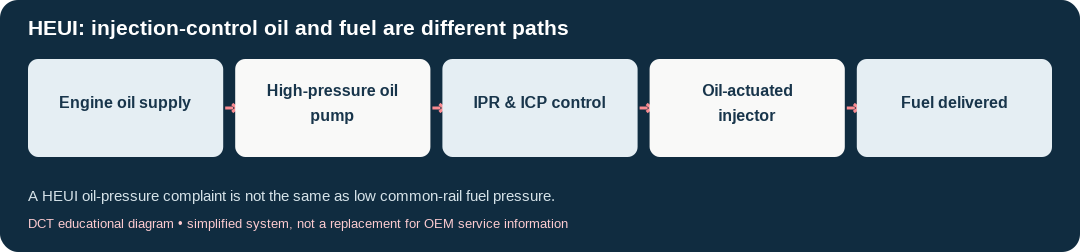
If you learned diesel diagnostics on common-rail engines, the older Power Stroke high-pressure oil system can seem as though someone moved the fuel-pressure problem into the lubrication circuit. That is an oversimplification, but it captures the difference: applicable 7.3L and 6.0L Power Stroke HEUI systems use pressurized engine oil to actuate the fuel injectors. The injectors still deliver fuel, yet the power needed to make them fire comes from oil pressure managed by a distinct hydraulic system. A healthy fuel supply alone cannot compensate for a missing injector-actuation oil pressure requirement.
Look up the exact meaning of 10 codes covered below
The relevant trouble-code family includes P2283 through P2287 for injector-control-pressure sensor circuits and performance, P2288/P2289 for high-pressure conditions or unusual engine-off readings, P2290/P2292 for low or erratic control pressure, and P2623 where the injector-pressure regulator circuit is monitored. Interpret all of these against the exact year and injection architecture. On later common-rail Ford diesels, the language of some codes such as P2291 may describe monitored fuel rail pressure rather than HEUI oil pressure.
Three components of a useful ICP investigation
First, the engine’s starting and running conditions must be credible: adequate cranking speed, proper oil level and condition, a sound electrical supply, correct engine synchronization signals, and no obvious conflicting faults. Second, the technician compares the pressure the controller wants with the pressure it believes it has and checks whether the sensor signal makes physical sense. Third, the high-pressure oil control and delivery path is assessed according to the OEM procedure, considering regulator command, internal leaks, pump capacity, oil temperature effects, and the relevant engine design.
Sensor faults demand particular caution. A circuit-low or circuit-high code is about monitored signal behavior; it is not an oil-pressure gauge reading. A high-pressure reading with the engine off may indicate implausible feedback, depending on the application. An intermittent code may be more revealing when connector condition, harness movement, temperature, and event timing are recorded than when an injector or oil pump is removed immediately.
How the IPR can change the starting story
The injector pressure regulator helps control the pressure available for HEUI actuation. If the regulator’s electrical control or hydraulic behavior is wrong, the engine may crank but fail to reach the conditions for injection, or it may run poorly. However, an electrical IPR code should not be converted straight into an order for a new regulator; wiring, connectors, power and driver behavior must be checked, and the pressure system evaluated in the manufacturer’s sequence.
For the older HEUI-specific relationship between requested and measured control pressure, use P1211/P1212. For an application-sensitive starting code, read P2291. The wider Power Stroke ICP hub explains where the systems diverge. Contact our diesel injection team if the vehicle-level investigation has isolated an injector-related component requiring evaluation; remember that oil-side problems may require specialized engine-side service rather than fuel component repair.
Injector control pressure sensor code reference
The sensor-code family separates a general circuit concern from behavior that looks implausible or electrically abnormal. P2283 refers to an injector control pressure sensor circuit condition, P2284 to sensor range/performance, P2285 to circuit low, P2286 to circuit high, and P2287 to an intermittent or erratic circuit. These terms identify what the controller detected; they do not establish that the hydraulic oil pressure itself is low or high. Interpret them alongside the precise engine architecture and current OEM service chart, especially when the code is shown on a platform that uses common-rail fuel pressure rather than HEUI oil actuation.
Frequently asked questions
Is an ICP sensor the same thing as a fuel rail pressure sensor?
Not on a HEUI engine. The ICP sensor monitors the engine-oil actuation pressure used by the injector system; a common-rail fuel pressure sensor measures a different hydraulic medium and operates in a different architecture.
Could P2289 be a defective sensor instead of real pressure?
Yes, sensor plausibility is a central part of diagnosis. A reading that conflicts with expected engine-off conditions should be verified through OEM service instructions before replacing hydraulic components.
Keep exploring the right evidence
Learn how 7.3L and 6.0L Power Stroke HEUI injector control pressure systems are diagnosed, and why newer Ford P2291 codes mean something different. Include injector or oil-control part numbers, the engine application, and relevant electrical or injection-control pressure tests.
Find your exact trouble code in this group
Separate high-pressure engine-oil generation and control from injector wiring and fuel supply on the relevant HEUI system. The individual descriptions below identify which monitor needs attention; the full guide explains the associated system.
| DTC | Monitored condition | Diagnostic distinction |
|---|---|---|
| P2283 | Injector control pressure sensor circuit fault | Sensor-circuit issue on supported injection control systems. |
| P2284 | Injector control pressure sensor range/performance | Sensor plausibility differs from a confirmed mechanical pressure fault. |
| P2285 | Injector control pressure sensor circuit low | Low sensor-circuit voltage/input. |
| P2286 | Injector control pressure sensor circuit high | High sensor-circuit voltage/input. |
| P2287 | Injector control pressure sensor intermittent | Erratic pressure sensing or circuit behavior. |
| P2288 | Injector control pressure too high | Excess pressure relative to the actuation strategy where equipped. |
| P2289 | Injector control pressure too high with engine off | Abnormal pressure reading with the engine off; verify whether sensor feedback is credible. |
| P2290 | Injector control pressure too low | Pressure label requires checking whether the application uses HEUI oil actuation or fuel rail pressure. |
| P2292 | Injector control pressure erratic | Unstable pressure or pressure feedback, application dependent. |
| P2623 | Injector control pressure regulator circuit fault | Control-circuit interpretation depends on HEUI-era hardware and OEM implementation. |
The code descriptions are general. Confirm the exact definition, engine application and OEM diagnostic procedure before relying on a component conclusion. High-pressure diesel fuel is hazardous; do not loosen live common-rail connections.