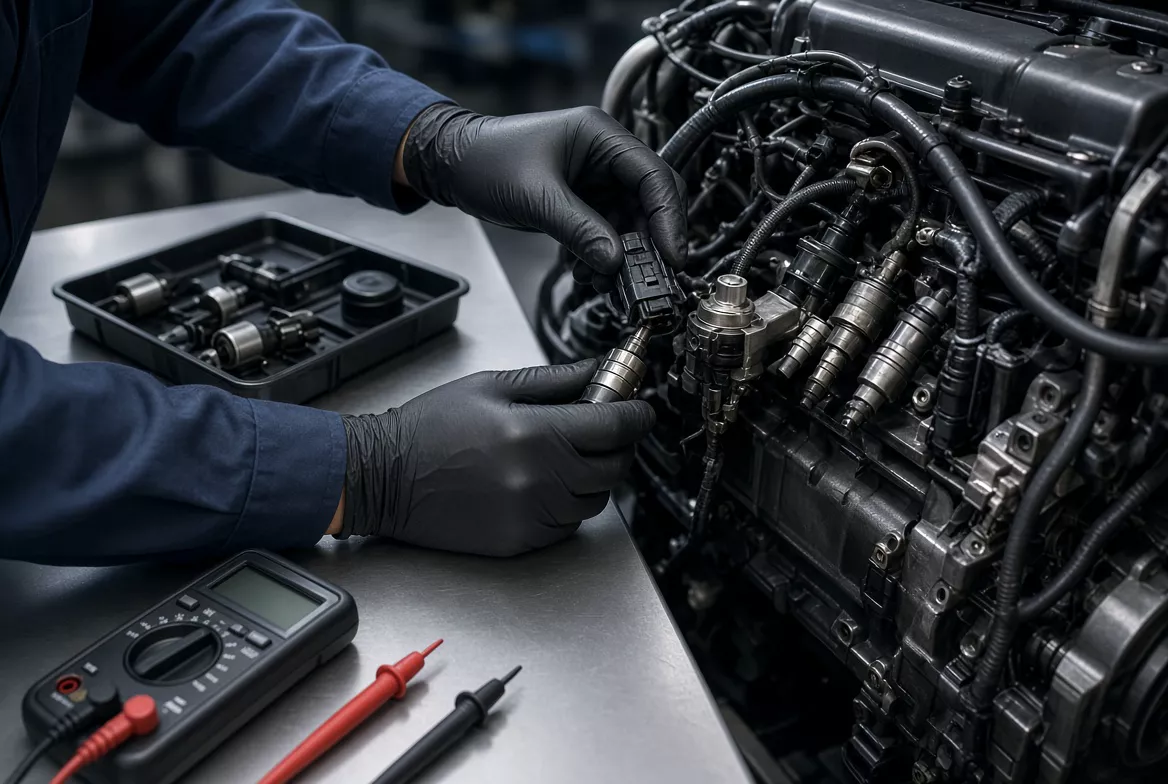
Precision diesel injection is about delivering exactly the fuel the engine needs, neither too little nor too much, at the right time. P026C is associated with fuel injection quantity below expectation, while P026D concerns quantity above expectation on supported applications. These are performance descriptions, not direct measurements made by a laboratory flow bench. They invite the technician to ask how the controller determines expected fueling and what might make its calculation disagree with engine behavior.
Look up the exact meaning of 2 codes covered below
P026C and P026D point in opposite directions
These related codes should be read using the exact OEM definition and engine application, not treated as a generic bad-injector code.
- P026C: Injected fuel quantity lower than expected, according to the applicable control strategy.
- P026D: Injected fuel quantity higher than expected, according to the applicable control strategy.
- Both require context: Record related codes, injector calibration/coding status and supported engine test observations before drawing a component conclusion.
Related guidance: Injector balance interpretation Injector coding and trim codes
Too little and too much have different effects
Insufficient delivery can contribute to low power, roughness, a weak cylinder or starting difficulty. Excessive delivery can influence smoke, combustion quality, noise and other symptoms. But those observations overlap with air and mechanical problems, and many engine control strategies infer injected quantity from indirect inputs. The diagnostic meaning depends on the monitor and engine, so a generic symptom should never override the specific service procedure.
Reasons quantity can appear wrong
Injector wear or restriction, abnormal electrical control, inadequate rail pressure, erroneous pressure feedback, incorrect injector coding, and calibration or mechanical influences can matter depending on the system. Fuel quality and previous repairs may also change the interpretation. If several cylinders are affected, shared pressure, supply or control should be considered before assuming a coincidental failure of multiple injectors.
A defensible path to injector testing
The technician records companion codes and relevant correction data, verifies fuel pressure and electrical operation, and follows OEM tests that can separate cylinder behavior from global fueling. If one injector emerges as a credible suspect, a suitable component evaluation may test delivery, leakage and electrical performance. If the source is pressure regulation, coding or an engine mechanical condition, an injector repair would not address the cause.
Related pages: restricted injectors, leaking injectors, injector offset learning and injector performance. Contact us with the engine details and test results if an injector needs closer evaluation.
Frequently asked questions
Does P026D mean an injector is stuck open?
Not necessarily. Higher-than-expected fuel quantity may be inferred through an application-specific strategy and requires more evidence than the code alone.
Can incorrect injector coding affect fuel quantity?
It can on systems that use individual injector calibration data. Check the manufacturer requirements after replacement or programming.
Keep exploring the right evidence
Learn how lower- or higher-than-expected injection quantity affects engine performance and why the injector is not always the only cause. Include the exact component number, equipment application, symptoms and checks already completed.
Find your exact trouble code in this group
Verify the affected cylinder and compare fuel-delivery evidence with compression, mechanical condition, wiring and other cylinder influences. The individual descriptions below identify which monitor needs attention; the full guide explains the associated system.
| DTC | Monitored condition | Diagnostic distinction |
|---|---|---|
| P026C | Fuel injection quantity lower than expected | Unexpectedly low injected quantity; establish whether injector, supply or data are responsible. |
| P026D | Fuel injection quantity higher than expected | Unexpectedly high injected quantity; possible injector, control and sensor influences. |
The code descriptions are general. Confirm the exact definition, engine application and OEM diagnostic procedure before relying on a component conclusion. High-pressure diesel fuel is hazardous; do not loosen live common-rail connections.