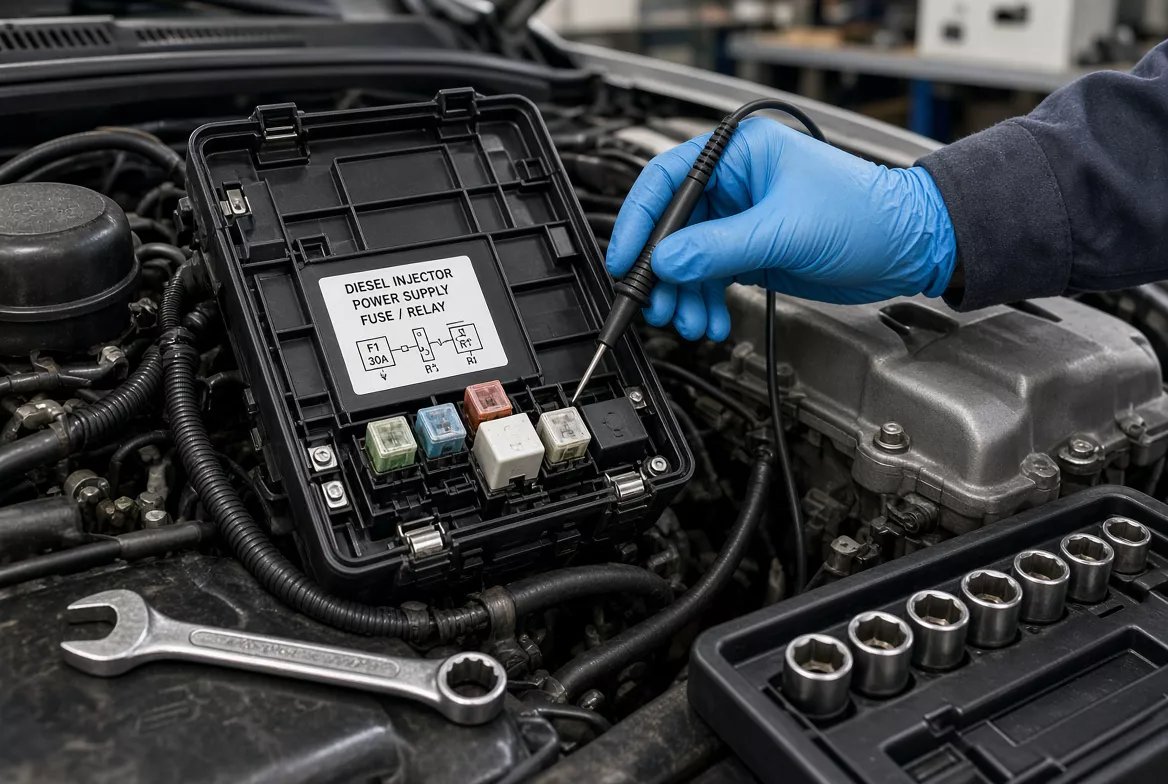
A high-pressure pump’s ability to build pressure depends not only on its mechanical design but also on how much fuel it is instructed to handle. The fuel volume regulator or metering actuator is part of that control story on equipped diesels. P0001–P0004 cover an open circuit, control range/performance, low circuit and high circuit condition respectively. That makes them especially useful in distinguishing a missing electrical instruction from an actuator that receives instructions but fails to produce the expected response.
Look up the exact meaning of 5 codes covered below
P0001–P0004: identify open, range, low and high correctly
These four metering or volume-regulator codes share a device family but do not describe the same failure mode.
- P0001: Check the applicable control-circuit open definition.
- P0002: Investigate range or performance according to the OEM strategy.
- P0003 / P0004: Separate low and high control-circuit indications from measured rail pressure.
Related guidance: Metering control P0251 Regulator performance P0089
The four fault directions
P0001 identifies a monitored open control circuit. P0002 indicates control range/performance outside expectation. P0003 and P0004 refer to low and high control-circuit states. The labels are not four different names for a mechanically worn pump. The technician must identify which device the manufacturer calls the fuel volume regulator, how it is energized, and what the controller monitors. A fault in wiring or driver supply could prevent normal metering even when the valve and pump are otherwise capable.
What happens to rail pressure?
Depending on the actuator’s fail-safe state and system architecture, incorrect metering may contribute to low rail pressure, high pressure, stalling or a no-start. Do not assume unplugging a valve will always drive pressure in the same direction across all engines. P0087 and P0088 can appear as secondary consequences, but their presence still does not prove the regulator is the sole cause. Low-side supply and sensor plausibility remain important diagnostic prerequisites.
What the right testing proves
A qualified technician studies the OEM schematic, verifies voltage and ground, uses authorized actuation tests, and examines commanded-versus-actual pressure behavior. A circuit test that passes does not prove mechanical metering performance; a hydraulic pressure deviation does not prove the circuit is bad. Those distinctions are why a systematic sequence is both faster and cheaper than replacing the pump assembly based on code wording alone.
Related: P0251, injection pump metering codes, and P0089. Contact our team with the engine and component information if a metering actuator or pump has been identified for evaluation.
What about P000E?
P000E, commonly described as fuel volume regulator control exceeded learning limit, belongs near the P0001-P0004 electrical-control family but represents a different problem. Rather than merely identifying an open, low, or high circuit state, it indicates that the controller’s adaptive strategy has reached a learned boundary on supported systems. It is possible for a control circuit to appear electrically sound while the system cannot achieve the requested fuel-volume behavior, so supply conditions, commanded control, sensor feedback, and applicable learned values may need to be evaluated together. Do not interpret a learning-limit code as permission to replace the regulator without following the OEM diagnostic process.
Frequently asked questions
Does P0001 always mean a bad fuel-volume regulator?
No. Open wiring, connector faults or a driver problem may cause the monitored circuit to appear open.
Are P0001 and P0251 interchangeable?
No. They belong to different code families and may refer to different devices or diagnostic strategies on a given engine.
Keep exploring the right evidence
Decode fuel volume regulator open, performance, low and high circuit faults and learn how metering valve tests differ from pump replacement. Include the exact component number, equipment application, symptoms and checks already completed.
Find your exact trouble code in this group
Identify the pump and metering arrangement; distinguish valve command, electrical feedback, fuel supply and actual pump delivery. The individual descriptions below identify which monitor needs attention; the full guide explains the associated system.
| DTC | Monitored condition | Diagnostic distinction |
|---|---|---|
| P0001 | Fuel volume regulator control circuit open | Electrical continuity issue associated with metering actuator control. |
| P0002 | Fuel volume regulator control range/performance | Actuator response or monitoring performance concern. |
| P0003 | Fuel volume regulator control circuit low | Low control circuit state; follow exact OEM schematic. |
| P0004 | Fuel volume regulator control circuit high | High control circuit state; follow exact OEM schematic. |
| P000E | Fuel volume regulator exceeded learning limits | Control adaptation has reached its calibration boundary; identify why correction is necessary. |
The code descriptions are general. Confirm the exact definition, engine application and OEM diagnostic procedure before relying on a component conclusion. High-pressure diesel fuel is hazardous; do not loosen live common-rail connections.