

Few phrases cause more confusion in diesel fault-code discussions than “injector control pressure.” On a 7.3L or 6.0L Power Stroke using HEUI injection, high-pressure engine oil provides the hydraulic force that actuates the injectors. On a later common-rail Power Stroke, the injection system instead relies on high-pressure diesel fuel in a rail. The fault-code vocabulary may overlap, but the hardware under investigation can be entirely different. The engine identification plate is therefore the first diagnostic tool.
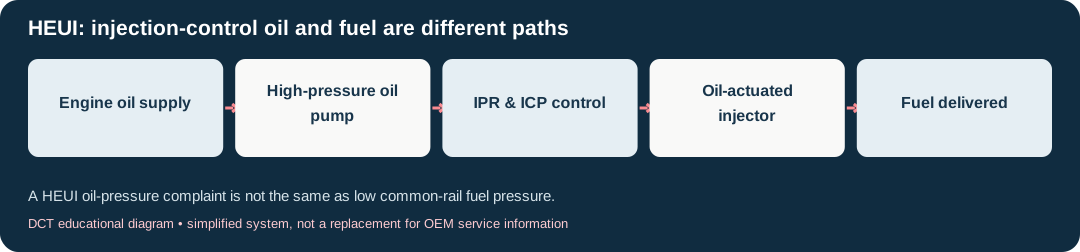
HEUI: fuel injection powered by oil pressure
On applicable HEUI engines, the high-pressure oil pump, injector pressure regulator, injector control pressure sensor, oil condition, leaks within the high-pressure oil system, and electrical controls influence whether injection can occur. P1211 is associated with ICP pressure failing to track the desired value on applicable 7.3L engines. P2283–P2287 may describe sensor circuit or plausibility problems where supported, while P2288/P2289 and P2290/P2292 relate to abnormal or erratic pressure behavior. The exact meaning and availability of each code must be confirmed for the engine and year.
P1212 warrants particular care because its definition is not safely universal across applications. Some code lists describe cranking-pressure problems, while historical documentation uses a different ICP-related label. A responsible service page should never attach a single fixed explanation to a manufacturer-controlled code without knowing the vehicle.
P2291 requires a generation check
P2291 during cranking is a compelling example. On a modern 6.7L common-rail Power Stroke, Ford’s 2023–2024 diesel diagnostic documentation describes the monitor in terms of high-pressure fuel rail pressure during cranking. It would be wrong to tell that owner to replace an HEUI high-pressure oil pump, because that component is not part of the same injection architecture. The owner’s symptoms may sound identical; the diagnostic tree is not.
Diagnosing pressure without crossing systems
For HEUI applications, relevant investigation may include oil level and condition, cranking speed, commanded and actual ICP, regulator response, and manufacturer-approved high-pressure oil leakage tests. For common-rail applications, it shifts toward low-pressure fuel supply, rail pressure, metering, leakage, fuel quality, and control circuits. Never loosen a running high-pressure fuel connection as a test. On either system, the correct pressure sensor and correct units matter; confusing oil pressure with fuel rail pressure can lead to an expensive, unsafe detour.
Codes in this category
| DTC or code family | What the fault describes | Diagnostic significance |
|---|---|---|
| P2291 | Injector control pressure too low during cranking | On modern Ford common-rail systems this may monitor fuel rail pressure; HEUI interpretations differ. |
| P2290 | Injector control pressure too low | Pressure label requires checking whether the application uses HEUI oil actuation or fuel rail pressure. |
| P1211 | 7.3L Power Stroke ICP actual versus desired | Confirmed on applicable 7.3L Ford HEUI applications; desired and measured oil-actuation pressure differ. |
| P1212 | Power Stroke ICP-related code—definition varies | Verify year and service manual; do not universally label it cranking pressure not achieved. |
| P2623 | Injector control pressure regulator circuit fault | Control-circuit interpretation depends on HEUI-era hardware and OEM implementation. |
| P2283 | Injector control pressure sensor circuit fault | Sensor-circuit issue on supported injection control systems. |
| P2284 | Injector control pressure sensor range/performance | Sensor plausibility differs from a confirmed mechanical pressure fault. |
| P2285 | Injector control pressure sensor circuit low | Low sensor-circuit voltage/input. |
| P2286 | Injector control pressure sensor circuit high | High sensor-circuit voltage/input. |
| P2287 | Injector control pressure sensor intermittent | Erratic pressure sensing or circuit behavior. |
| P2288 | Injector control pressure too high | Excess pressure relative to the actuation strategy where equipped. |
| P2289 | Injector control pressure too high with engine off | Abnormal pressure reading with the engine off; verify whether sensor feedback is credible. |
| P2292 | Injector control pressure erratic | Unstable pressure or pressure feedback, application dependent. |
Read P1211/P1212, P2291, and Power Stroke engine-specific diagnostics. When you contact our team, include the engine displacement and model year so we can talk about the correct injection system from the start.
Keep exploring the right evidence
Decode P1211, P2290, P2291, P2283–P2289 and related Power Stroke injection pressure codes with the correct engine-specific context. Include the injector or nozzle number, engine identification, relevant cylinder observations and any completed injector testing.