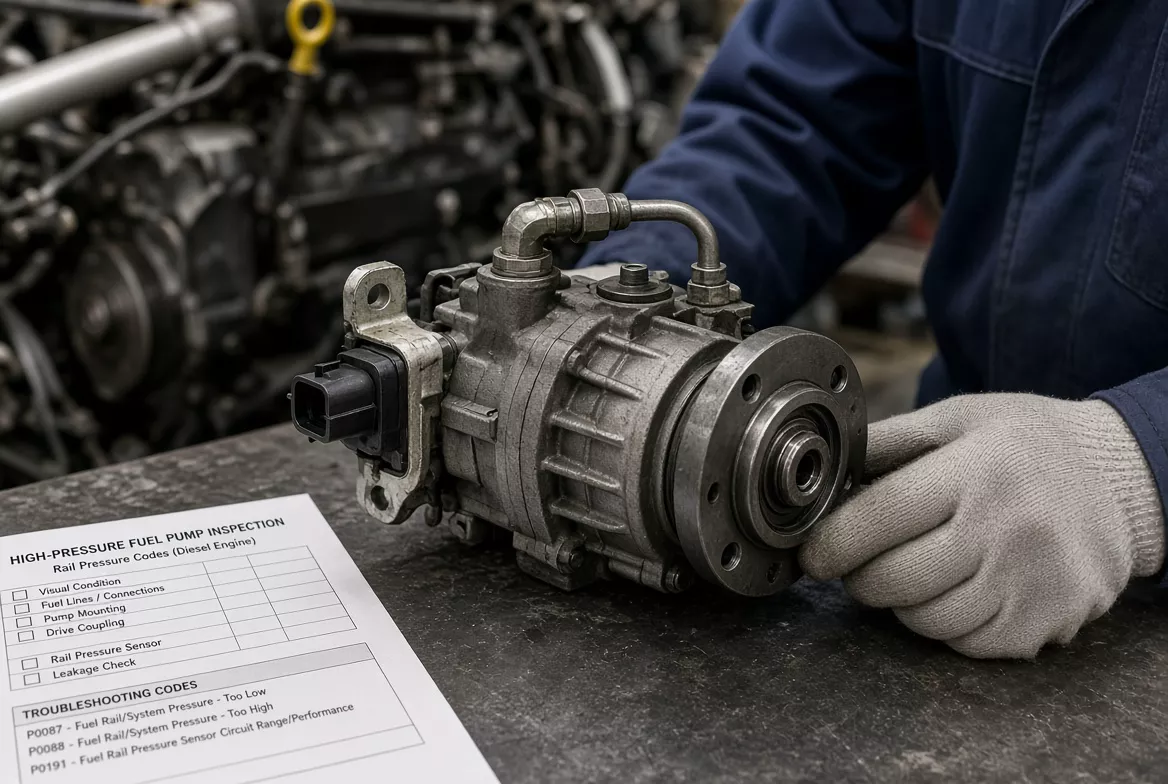
A diesel that feels strong at idle and lazy on the road can be maddening. It pulls normally for a few miles, then loses power when the trailer gets heavy or the hill gets steep. The instrument cluster may display a warning, the engine may enter reduced-power operation, and the driver begins searching for a turbocharger, fuel pump or injector problem. The good news is that the circumstances often provide valuable evidence. The challenge is to use that evidence without deciding the failed component too soon.
Why fuel demand matters
During acceleration or towing, the engine requests more fuel and, on applicable common-rail systems, different rail pressure and injection behavior. A marginal fuel filter, weak low-pressure supply stage, air intrusion, excess return leakage, metering fault or high-pressure pump limitation may not appear at idle but can become obvious when demand rises. P0087 and, on certain Duramax applications, P1093 fit this story. They describe a pressure-delivery shortfall, not a particular failed part.
It might not be the fuel system
Turbocharger boost-control faults, charge-air leaks, restricted air paths, exhaust aftertreatment limitations, sensor problems and protective temperature strategies can produce similar reductions in power. A healthy fuel system cannot deliver normal performance if the engine controller is deliberately limiting torque for another reason. That is why a technician reads all available DTCs and operating data before interpreting the most familiar fuel-pressure code as the complete explanation.
How to record a useful complaint
Write down the circumstances: engine speed, whether the truck was towing, outside temperature, duration of the pull, fuel level, and whether power returns after a restart. If the vehicle has been tuned or had injectors, filters, a pump or a relief device replaced, note when that work happened. The scan tool should preserve freeze-frame and companion codes rather than clearing them immediately. This is especially valuable for an intermittent failure that cannot easily be duplicated in the shop.
What a fuel-pressure investigation checks
On a common-rail system, the technician compares commanded and actual pressure and confirms that the pressure sensor is credible. Low-side pressure and flow must be evaluated at the right operating condition. The next questions concern metering commands, relief behavior, possible injector leakage and the ability of the high-pressure pump to meet demand. If the evidence points away from fueling, the diagnosis shifts to air, exhaust, control or engine protection rather than continuing to replace fuel components.
A pump bench test can be useful when the vehicle-level evidence isolates inadequate pump performance under proper supply and control conditions. Injector testing can be useful when correction, leakage or cylinder-specific data implicate one or more injectors. Neither test should be sold as a universal first step for every low-power truck.
Keep the truck and the diagnosis safe
Unpredictable power loss can be dangerous in traffic or while towing, particularly if the engine stalls. Reduce the load, avoid risky driving situations and arrange a professional assessment. Do not loosen pressure lines or attempt improvised load tests around a running high-pressure fuel system. Safety comes before reproducing a dramatic symptom.
Where to read next
Start with P0087 if the rail pressure is low, P008A if low-side supply is implicated, P1093 if the truck is an applicable Duramax, and P0191 if rail-pressure feedback is suspect. If the diagnosis identifies an injection component, contact our diesel injection team with the measured data to discuss evaluation options.
Frequently asked questions
Does limp mode always mean an injection pump problem?
No. Reduced-power strategies can be triggered by fuel, air, exhaust, temperature, electronic control and other conditions. The full code set and operating data are essential.
Why does the truck have power at idle but not on hills?
Demand is much higher under load. A marginal supply or pressure-control system may meet low demand but fail when the engine asks for more, although non-fuel problems can create the same pattern.
Can an injector problem cause power loss without a cylinder-specific code?
It can on some systems, but the lack of a cylinder-specific code neither proves nor rules out an injector defect. The required evidence comes from the engine’s diagnostic strategy and appropriate tests.
Keep exploring the right evidence
A diesel losing power under load may have P0087, P1093, supply restrictions or other problems. Learn how to separate injection faults from other engine issues. Include the exact component number, equipment application, symptoms and checks already completed.
Low power under load: compare supply, boost and commanded derate
A complaint under towing or acceleration may correlate with P0087 fuel-rail pressure, but P0299 underboost, exhaust aftertreatment restrictions or an electronic derate can produce similar symptoms. Record the load and engine speed at fault, companion codes, pressure trends and actual boost response before blaming an injection pump. Avoid sustained high load when a serious fuel-system fault remains unresolved.