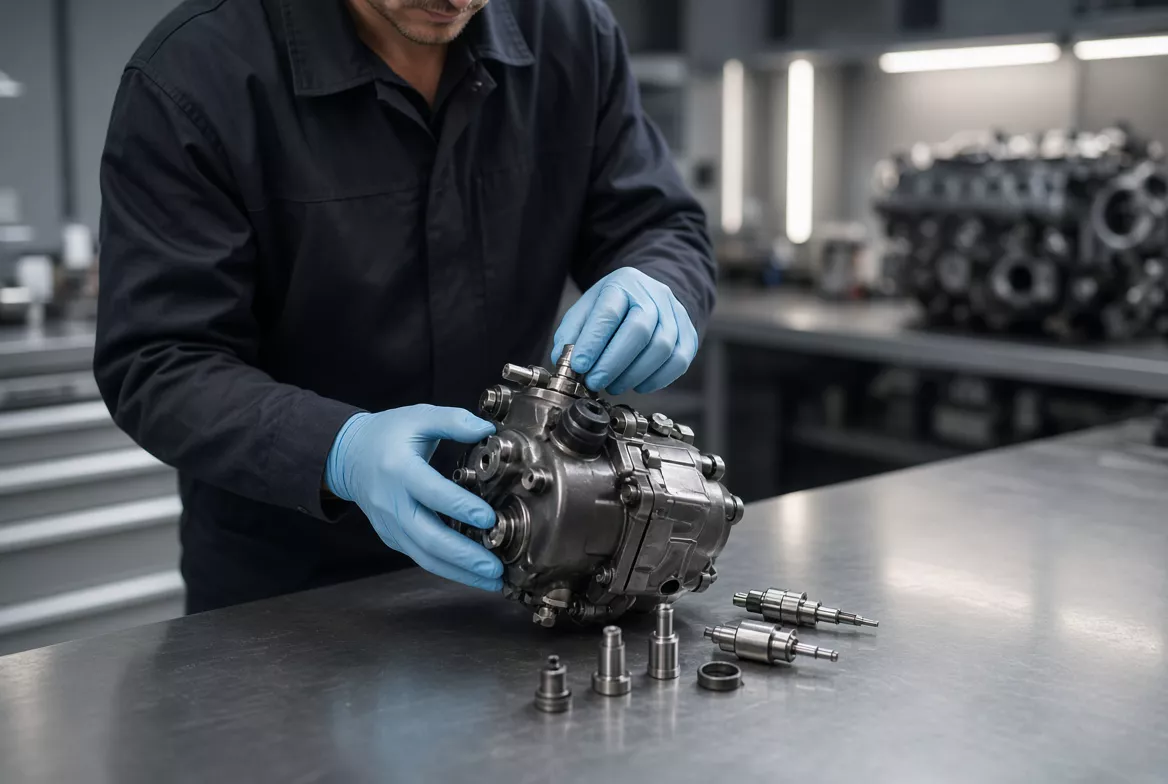
There are three tempting answers to a failed pump: fix it, rebuild it, or buy another one. The smart answer depends on what failed, what the pump is worth, what parts still exist, and whether the rest of the fuel system is healthy.
Repair: fix a known problem
A targeted repair can make sense when diagnosis identifies a limited defect and the remainder of the assembly meets the necessary criteria. A visible leak, for example, should not automatically trigger the same scope of work as severe internal damage.
Rebuild: go deeper
A rebuild may involve controlled disassembly, examination of precision components, replacement of required wear items, reassembly, and testing or calibration. The parts changed and test standard should be explained in the job details. “Rebuilt” is not a substitute for documentation.
Refurbishment: ask what it actually includes
Refurbishment is often used more broadly than rebuilding. It may describe cleaning and restoring a unit, but it does not inherently promise new internal components or full calibration. Request a written scope.
Replacement: sometimes the most responsible option
Severe contamination, irreparable mechanical damage, unavailable parts, damaged housings, and certain non-serviceable electronic or common-rail components may favor replacement. The correct decision also accounts for installation, downtime, and the risk of repeat work.
Five questions to ask the shop
What failure was found? What work is proposed? What verification follows the work? What system-level contamination or installation work is necessary? What scope, technical limitations, return requirements and warranty conditions apply?
A credible repair decision can answer these without pretending every pump is rebuildable.
Rebuild, remanufactured exchange or new: the practical trade-offs
The Three Options in Plain English
Rebuild the original. The original pump is evaluated for serviceability. After inspection and approval, the shop repairs serviceable components, performs applicable testing or calibration and returns the original assembly.
Remanufactured exchange. If a compatible exchange unit is available, a remanufactured assembly is supplied and the original unit may be returned as a core under the program’s terms.
New. A factory-new pump from the original manufacturer, when one exists. For many older pumps, new production ended long ago.
Shop Talk: A core is your old, rebuildable pump. A core return requirement is a deposit that may be refunded according to the seller’s acceptance requirements for the returned assembly. It’s how exchange programs keep good pumps in circulation.
Not every seller uses “rebuilt” and “remanufactured” the same way. Some use reman to mean every wear part is replaced to a standard; others use the words interchangeably. Do not shop by the label alone. Ask what work is included and what verification records are available.
The Comparison Table
| Factor | Rebuild your pump | Reman exchange | New |
|---|---|---|---|
| Service scope | Condition and approved work | Exchange-unit eligibility and core conditions | Replacement-unit compatibility and availability |
| Technical factors | Wear, electronics and calibration | Pump family, core condition and compatibility | Manufacturer application and availability |
| Availability | Requires evaluation and approved work | Depends on a compatible exchange unit | Depends on replacement parts availability |
| Sold-component warranty | DCT two-year purchase-date coverage on sold new, rebuilt and remanufactured components | DCT two-year purchase-date coverage on sold rebuilt or remanufactured units | DCT two-year purchase-date coverage on sold new components |
| Core | None, it’s your pump | Return required; damage can reduce the refund | Depends on the seller |
| What you receive | The original pump after applicable service | An approved compatible assembly | A new assembly matched to the application |
| Often considered for | Rare or matched original pumps | Compatible programs where available | Nonrepairable or unsupported assemblies |
Did You Know? Bosch gives its own remanufactured pumps different part numbers from new ones. A new CP3 carries a 0 445 020 number, while a Bosch reman CP3 starts with 0 986 437. The VP44 does the same: 0 470 506 new, 0 986 444 reman.
Request a Mail-In Repair Evaluation: Start your repair inquiry
How mail-in service works | Browse pump families