
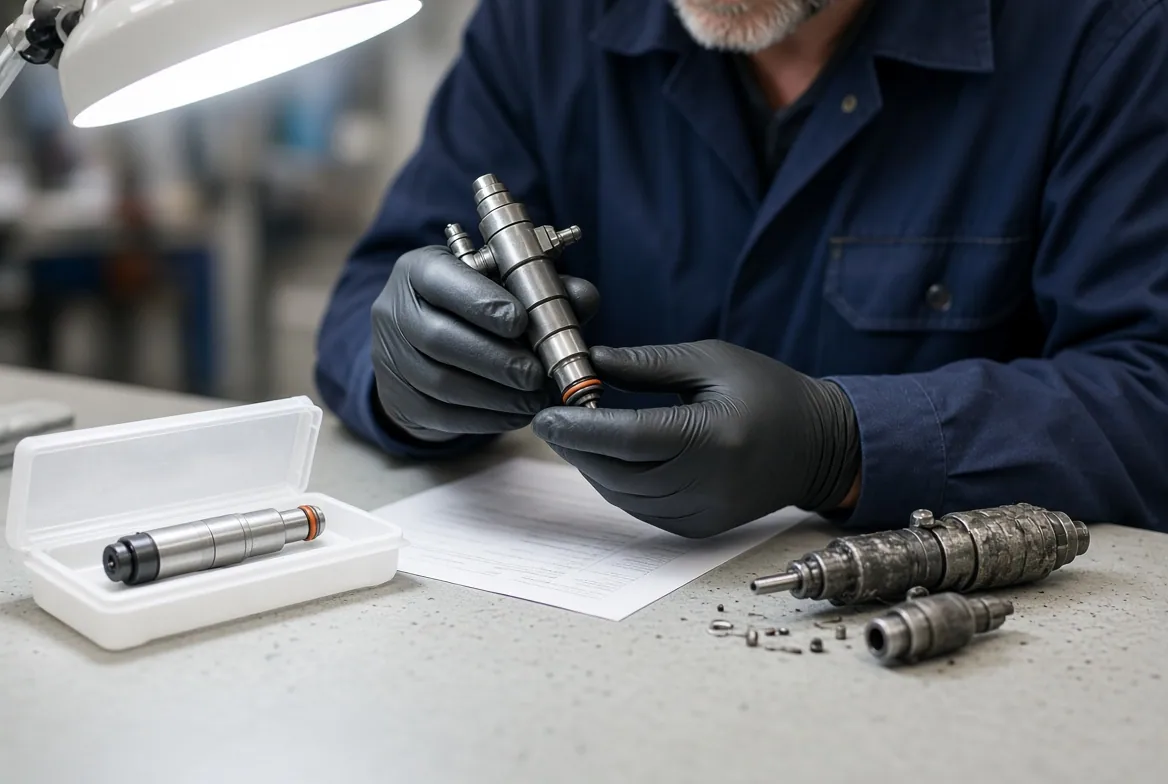
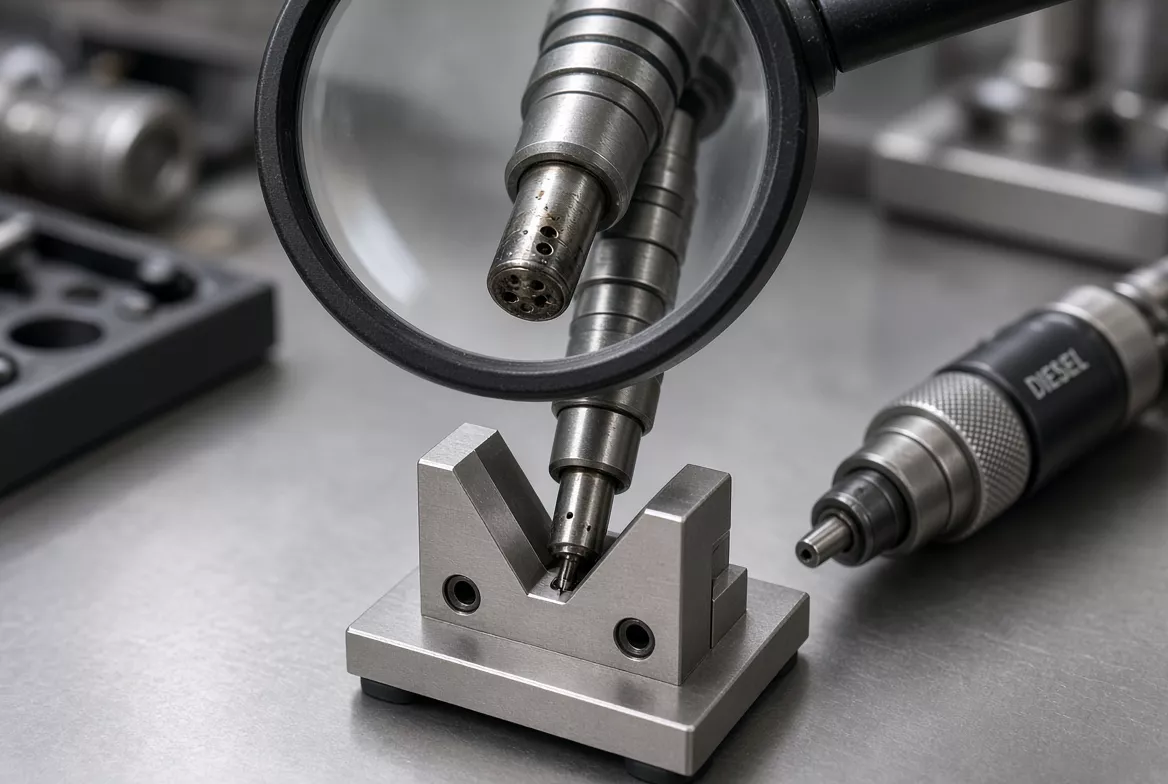
New injectors are built entirely from new components. Remanufactured injectors start as used cores and go through a defined industrial process: disassembled, cleaned, fitted with new wear parts to a set standard, and tested to a specification intended to match new-part performance. Rebuilt injectors are used injectors repaired to working condition, with parts replaced as needed. Their quality depends almost entirely on who did the work and how they tested it.
Those definitions are the common understanding. The aftermarket uses all three words loosely, though, so the label on the box tells you less than the answers to a few specific questions.
How the options compare
| New | Remanufactured | Rebuilt | Cleaned and tested | |
|---|---|---|---|---|
| Starting point | New parts | Used core | Used core | Your used injector |
| Wear parts replaced | New manufacture | Defined by approved process | By supported repair scope | Usually no parts unless separately authorized |
| Testing standard | Factory | Defined test plan | Varies by shop | Varies by shop |
| Consistency | Controlled by manufacturer | Depends on reman process | Depends on scope and testing | Depends on starting condition and final test |
| Core return | No | Usually | Usually or your own unit | Your own unit |
| Typical use | Any | Most repairs | Common or older parts | Deposits, marginal injectors |
What “remanufactured” should mean
A credible remanufacturing process uses a defined parts and inspection standard, identifies the exact injector design, and performs appropriate final verification. Which precision parts are replaced depends on the supported process—not every injector family has identical serviceable parts. Where a replacement requires coding or new calibration data, those must be supplied or confirmed under the specific engine and injector instructions. More on that in diesel injector coding and trim codes.
The result should perform like a new injector. Original-equipment manufacturers run their own remanufacturing programs, and qualified independent remanufacturers do the same work.
What “rebuilt” can mean
At its best, a rebuild is a careful repair: the injector is tested, torn down, inspected, fitted with new parts where needed, reassembled and tested again. At its worst, it’s a new seal kit and a quick spray test. Both get called “rebuilt.”
That’s not a reason to avoid rebuilt injectors. For older and less common injectors, a skilled rebuild may be the best option available. It is a reason to ask questions.
Questions to ask about any replacement injector
- Is it new, remanufactured, rebuilt, or cleaned and tested? Ask the seller to say which.
- Which parts were replaced? On a common-rail injector, was the nozzle replaced? The control valve?
- What test plan was used, and can you see the results? Multiple test points, or a single flow check?
- Does it come with a trim code, if your engine uses one?
- Is it the same part number as yours, or a superseding number that’s approved for your engine?
- Are the injectors in a set matched, or tested individually?
- What are the core requirements? What condition must your old injector be in?
- What does the warranty cover, and what voids it? Most injector warranties exclude contamination damage. See why diesel injector warranty claims get denied.
Be careful with “new” from unknown sources
Genuine new injectors come through manufacturer distribution channels. Injectors offered as “new” through unfamiliar online sellers, especially with packaging that imitates a major brand, may be copies or used parts sold as new. If a deal looks too good, ask where the injector came from and check the markings against a known genuine part.
Which one is right for you?
- For most common-rail engines with failed injectors, a remanufactured set from a reputable source is the usual choice.
- For engines under manufacturer warranty or with strict fleet specifications, new or OE-remanufactured may be required.
- For older, rare or mechanical injectors, a quality rebuild of your own injectors may be the most practical route.
- For injectors that test marginal from deposits, cleaning and testing your own set can be enough.
Manufacturer reference: Bosch: Diesel Repair Network and supported component service For procedures and specifications, use the current manufacturer information for your engine and model year.
Get options for your part number
Because manufacturer relationships and service eligibility can vary by exact product, please confirm the component number and supported scope with DCT rather than assuming that a brand listing establishes authorization or availability. Browse manufacturer references.
QUESTIONS ABOUT YOUR DIESEL COMPONENT?
Need guidance on Remanufactured vs Rebuilt vs New Diesel Injectors?
New, rebuilt and remanufactured injectors are not interchangeable labels. Compare how scope, testing, specifications and documentation affect the choice for a particular application. Include the injector or nozzle number, engine identification, relevant cylinder observations and any completed injector testing.