
The starter is doing its job, the engine is turning over, and nothing happens. Then the scanner reveals P00C6, a code associated with fuel rail pressure being too low during the cranking phase. Unlike a power-loss fault that appears after the truck is moving, this one focuses attention on a narrow moment: the engine must build sufficient pressure for the injection system to begin functioning normally, and that requirement is not being met under the monitor’s conditions.
P00C6 — Rail pressure too low during cranking. Starting-phase pressure criterion was not achieved; cranking speed and fuel delivery prerequisites matter.
P00C6 is about pressure during the crank event
A no-start pressure deficit during cranking is not the same diagnostic observation as pressure loss under load.
- Capture the start attempt: Record cranking speed, battery condition, requested and measured rail pressure where available.
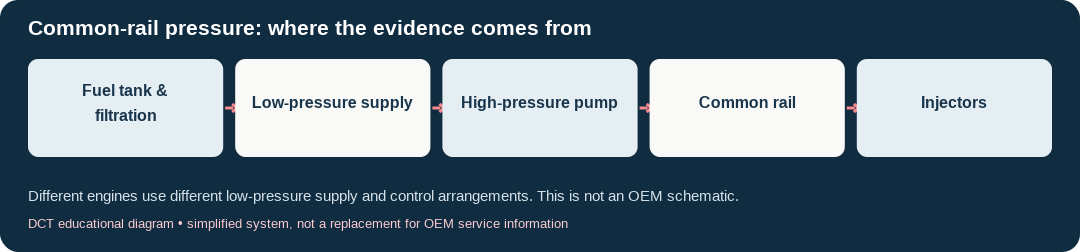
- Check the supply side: Filter restriction, air entry and low-side delivery can prevent the expected rail-pressure rise.
- Preserve code context: Save related codes and freeze-frame data before clearing, and use engine-specific test thresholds.
Related guidance: Cranks-but-will-not-start triage P0087 under-demand context
Why starting is a special fuel-system test
Common-rail diesel injection requires a coordinated sequence. The controller needs valid engine-position and speed information, appropriate electrical supply, available fuel, functional metering, and sufficient rail pressure. A cold or slow-cranking engine may behave differently from a fully warmed engine. P00C6 reports a monitored pressure shortfall; it does not reveal whether the supply is missing, pressure is escaping, the pump is inadequately controlled, or the pressure measurement itself is unreliable.
A useful question is whether measured pressure rises at all, rises too slowly, or builds and collapses. Those patterns can guide the next test. The required starting pressure is specific to the engine and the monitor, so a pressure threshold copied from another truck is not an acceptable substitute for service information.
What can prevent pressure from building?
Low fuel level, inadequate low-pressure supply, restricted filtration, air in the circuit, incorrect fuel, excessive injector internal return, pressure-relief leakage, a metering-control issue, and insufficient high-pressure pump performance are among the possibilities on suitable systems. Cranking speed, battery condition, and engine-control prerequisites must also be considered. A technician may encounter the same driver complaint with an electrical control or synchronization fault, even when fuel pressure hardware is healthy.
A leaking injector can be especially frustrating because the fuel may return internally instead of appearing outside the engine. A pump may also be blamed because the measured rail pressure stays low, when a restriction upstream prevents it from receiving enough fuel. Both situations demonstrate why the starting sequence has to be assessed as a system, not as a contest to see which component can be replaced first.
How the complaint is diagnosed
The technician records P00C6 and related DTCs, confirms cranking speed and battery conditions, and examines requested versus actual pressure during a controlled start attempt. Next come the applicable low-pressure supply checks, sensor and metering circuit verification, and manufacturer-defined leakage or delivery tests. Exact procedures differ between common-rail engines, and high-pressure systems require approved isolation and depressurization methods. Do not loosen an injector line to “see if it gets fuel.” That old shortcut is unsafe and potentially misleading on modern systems.
If the engine has recently had a fuel-filter change, pump replacement, injector installation, or tank service, the technician should pay particular attention to priming, air intrusion, assembly details, and required coding. Not every new no-start is a new component failure. The service history often provides the clue the code itself cannot.
Repair decisions based on evidence
Once the faulty part of the starting process has been isolated, the answer may be restoring supply, fixing a control circuit, correcting a leak, replacing or repairing a component shown to be defective, or addressing another engine prerequisite. If testing implicates an injector or high-pressure pump, contact our facility with the actual pressure trace and previous findings to discuss appropriate evaluation. A sensible repair begins with a defensible diagnosis.
P00C6 frequently asked questions
Is P00C6 proof that the high-pressure pump is bad?
No. It shows a rail-pressure shortfall during cranking, not the reason for it. Supply, electrical control, sensor feedback, and internal leakage may need evaluation before pump performance can be judged.
Why will my truck start after repeated cranking?
Intermittent supply, air, temperature, pressure retention, electrical, or sensor conditions may affect the time needed to achieve a starting threshold. Extended cranking should not be used as a substitute for diagnosing the root cause.
What related article should I read?
Start with our diesel cranks but won’t start guide, then compare P0087 and P008A if those codes are also present.
Keep exploring the right evidence
Understand P00C6 when a diesel cranks but will not start, including fuel supply, pressure buildup, injector return and pump-control possibilities. Include the exact component number, equipment application, symptoms and checks already completed.