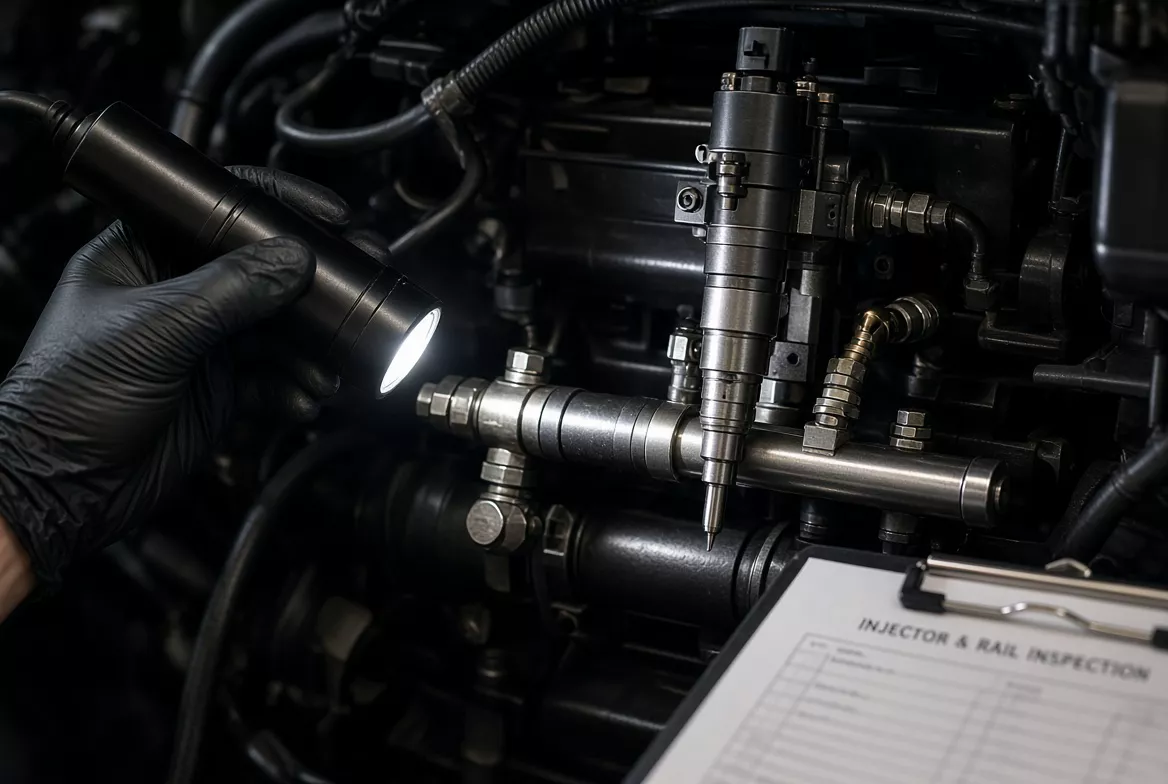
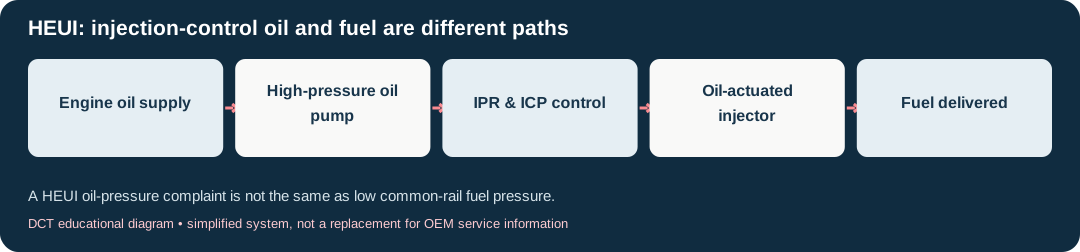
On a 7.3L Power Stroke, the fuel injector does not operate like a modern common-rail injector. High-pressure engine oil provides the hydraulic force that actuates the HEUI injector, making oil pressure a direct player in fuel delivery. When that actuation system cannot maintain the expected relationship between commanded and actual pressure, the engine may run poorly or fail to behave as the controller expects. P1211 is an important clue within that system, but its neighbors—especially P1212—need careful identification.
Look up the exact meaning of 2 codes covered below
P1211 and P1212 on 7.3L Power Stroke: preserve the oil-pressure context
On applicable HEUI engines, injector actuation relies on high-pressure engine oil; the two codes require their particular manufacturer definitions.
- Operating condition matters: Record cold/hot state, start, idle or load, and the exact code description.
- Compare commanded and measured ICP: Use the approved scan-tool procedure where available; verify sensor and regulator control evidence.
- Avoid single-part diagnosis: Oil quality, leakage, sensing and actuation can overlap with fuel-system symptoms.
Related guidance: HEUI operating guide ICP/IPR circuit explanations
P1211: pressure above or below the desired value
Ford’s 2002 model-year 7.3L diesel OBD documentation identifies P1211 as an injector control pressure condition in which actual ICP differs from the desired level while the engine is operating. That does not automatically mean the high-pressure oil pump has failed. The ICP sensor may be providing inaccurate information, the IPR may not regulate as expected, or the system may contain a high-pressure oil leak or another actuation limitation. Oil level, condition, temperature, engine speed, and electrical integrity all influence the diagnostic picture.
A useful diagnosis compares the desired ICP, actual ICP, and relevant regulator command or duty data while reproducing the symptom under approved conditions. If pressure consistently fails to track command, the technician investigates whether the problem is a missing hydraulic supply, escaping oil, control response, or erroneous feedback. A number displayed by the scan tool is not a complete hydraulic test, particularly when the sensor is part of the question.
P1212: do not borrow a definition from the wrong system
P1212 is sometimes described as “ICP not achieved during cranking,” but code definitions have varied by manufacturer, model year and platform. Confirm the engine, calibration, scan-tool interpretation and OEM service description before diagnosing a specific vehicle. The correct definition is the starting point for the right tests.
What HEUI symptoms can look like
An injection-control pressure concern may contribute to difficult starting, rough running, lack of power, or stalling. Cold and hot engine behavior can differ because oil condition and the sealing of the high-pressure oil system can influence performance. But electrical injector faults, fuel supply limitations, engine speed and position sensors, and mechanical engine conditions can produce overlapping complaints. A complete assessment does not stop at the most famous HEUI components.
The sensible diagnostic sequence
A technician confirms engine generation, oil level and condition, correct cranking and charging conditions, relevant stored faults, and the actual versus desired ICP data. Appropriate electrical tests of the IPR and sensor, plus manufacturer-approved oil pressure and leakage procedures, follow as indicated. Working on high-pressure oil and electrical injector components carries hazards; testing must use the correct equipment and instructions. A generic internet “unplug it and see” trick is not a substitute for service procedures.
For modern 6.7L Power Stroke owners who have encountered P2291, the comparison is instructive: that engine uses common-rail fuel pressure rather than the older HEUI actuation architecture. Visit the Power Stroke pressure-code center or engine-specific guide to keep the systems separate.
When to seek component evaluation
If the investigation actually identifies a fuel injector performance concern, specialized injector evaluation may make sense. If the root cause is in high-pressure oil actuation or its controls, the repair plan must address those components instead. Contact our diesel injection team with the engine year, exact DTC text, and tests performed; accurate identification is more valuable than a hurried parts order.
Frequently asked questions
Does P1211 mean the HPOP needs replacing?
Not without testing. An ICP discrepancy can result from hydraulic leakage, sensor or regulator problems, oil conditions, or other system issues.
Is P1212 always a no-start pressure code?
No fixed interpretation should be assumed without checking the exact vehicle’s manufacturer service information. The code description and applicable procedure may vary.
Can a 7.3L Power Stroke have fuel supply and ICP issues at once?
Yes. Fuel supply and oil actuation are different systems, and symptoms can overlap. A correct diagnosis verifies each relevant prerequisite rather than choosing one based on reputation alone.
Technical reference
The Ford 2002 7.3L diesel OBD system operation summary documents the older HEUI pressure monitor and the P1211 actual/desired relationship. It should be read as historical evidence for the covered engine, not as a decoder for later common-rail Power Strokes.
Keep exploring the right evidence
Understand P1211 ICP pressure above/below desired and why P1212 needs model-year verification before diagnosing 7.3L Power Stroke HEUI faults. Include the exact component number, equipment application, symptoms and checks already completed.
Find your exact trouble code in this group
Separate high-pressure engine-oil generation and control from injector wiring and fuel supply on the relevant HEUI system. The individual descriptions below identify which monitor needs attention; the full guide explains the associated system.
| DTC | Monitored condition | Diagnostic distinction |
|---|---|---|
| P1211 | 7.3L Power Stroke ICP actual versus desired | Confirmed on applicable 7.3L Ford HEUI applications; desired and measured oil-actuation pressure differ. |
| P1212 | Power Stroke ICP-related code—definition varies | Verify year and service manual; do not universally label it cranking pressure not achieved. |
The code descriptions are general. Confirm the exact definition, engine application and OEM diagnostic procedure before relying on a component conclusion. High-pressure diesel fuel is hazardous; do not loosen live common-rail connections.