
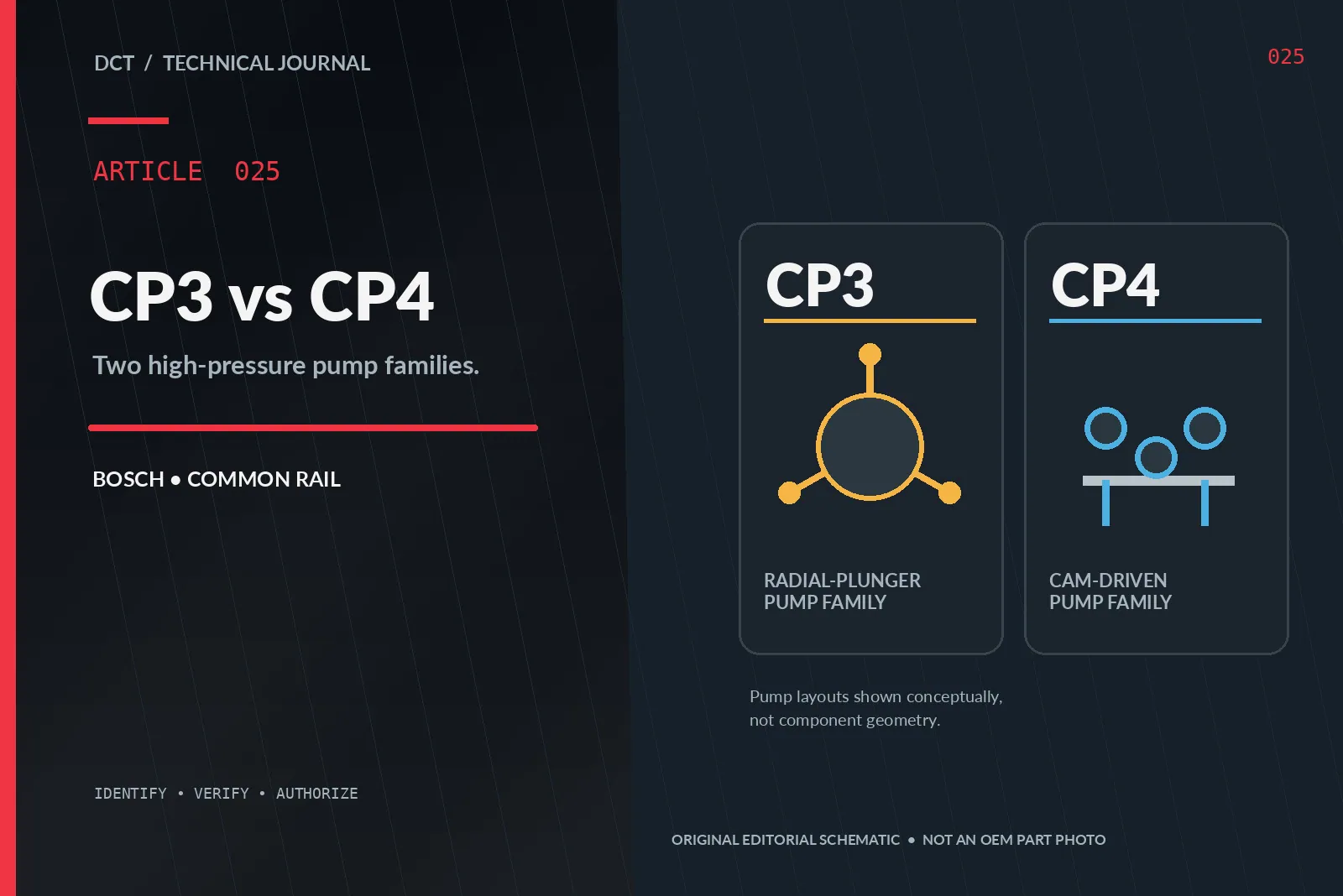
The CP3 and CP4 are both Bosch high-pressure pumps for common-rail diesels, but they’re built differently. The CP3 uses three radial pumping pistons driven by an eccentric shaft through a polygon-shaped ring, a layout that has proven very tolerant of real-world fuel. The CP4 uses one or two pistons (CP4.1 and CP4.2) driven by a cam through roller tappets. It’s more efficient and capable of high pressure, but it depends heavily on fuel lubrication between the cam and rollers. When that lubrication breaks down, the pump can wear rapidly and shed metal into the fuel system.
CP3 versus CP4: comparison is not a replacement approval
The design names describe different Bosch pump families. They do not by themselves establish whether a different pump can be fitted to a given engine.
- Identify what is installed: Record the pump's own complete assembly number and the engine calibration.
- Distinguish the question: Design, contamination risk and conversion fitment are separate topics requiring separate evidence.
- Avoid universal conclusions: A failure scenario, repair scope or interchange decision requires the exact platform and manufacturer guidance.
Related guidance: CP4 contamination assessment CP3-to-CP4 conversion questions
That’s the root of the CP4’s reputation among pickup owners.
Who uses which
| Engine | Model years | Pump |
|---|---|---|
| Duramax LB7, LLY, LBZ, LMM | 2001–2010 | CP3 |
| Duramax LML / LGH | 2011–2016 | CP4.2 |
| Duramax L5P | 2017 onward | Denso HP4 (not Bosch) |
| Cummins 5.9 common rail | 2003–2007 | CP3 |
| Cummins 6.7 (Ram pickups) | 2007.5–2018 | CP3 |
| Cummins 6.7 (Ram Heavy Duty) | 2019–2020 | CP4.2 |
| Cummins 6.7 (Ram Heavy Duty) | 2021–2024 | CP3 |
| Cummins 6.7 (Ram Heavy Duty) | 2025 onward | Bosch CP8 |
| Ford 6.7 Power Stroke | 2011 onward | CP4.2 |
Confirm your pump from its own label rather than the model year alone, since running changes and prior repairs happen.
The design difference that matters
CP3: eccentric and polygon ring
Inside a CP3, the drive shaft has an eccentric section that moves a polygon ring. Three pistons ride on the flats of that ring, arranged radially at 120-degree intervals. The pistons are pushed outward through a broad contact area. The design is heavier and larger, but the contact surfaces are forgiving.
CP4: cam and roller tappets
A CP4 uses a cam with lobes and a roller tappet for each piston. As the cam turns, the roller should roll along the lobe and push the piston. The roller and cam rely on a thin film of fuel. If that film breaks down, because of poor lubricity, water or air in the fuel, the roller can stop rolling and start sliding. Sliding contact wears the roller and cam quickly, and the steel particles that result travel with the fuel.
The CP4 is smaller and more efficient, and it can handle very high pressures. Its weak point is the very thing that makes it efficient: concentrated contact that leaves little margin when lubrication fails.
Why some CP4s fail and others don’t
Plenty of CP4 pumps run for a very long time. Factors commonly linked to failure include:
- Water in the fuel, which destroys lubrication
- Air or vapor reaching the pump from supply-side problems
- Fuel lubricity: US diesel’s lubricity limit (a maximum 520-micron wear scar in the HFRR test) is less stringent than Europe’s 460 microns, and this is often cited as one reason the pump has struggled more in North America
- Running the tank very low, which can draw air
- Contaminated or wrong fuel, including gasoline or DEF
What a CP4 failure costs you
When a CP4 sheds metal, the debris doesn’t stay in the pump. It can reach the rail, high-pressure lines and injectors, and on some systems it can be carried back toward the tank. That’s why manufacturer-approved repairs for a debris failure usually involve replacing far more than the pump. Our article on Bosch CP4 pump failure covers what’s affected and what a complete repair involves.
CP3 versus CP4 design is not the same as conversion fitment
This article compares pump design and service evidence. If the goal is to replace a CP4 with a different design, review the separate conversion decision guide before evaluating application compatibility, controls or emissions requirements. Neither pump family name proves a drop-in substitution.
Should you convert to a CP3?
Conversion kits that replace a CP4 with a CP3 or another pump are sold for several of these trucks, and some owners choose them after a failure or as prevention. If you’re considering one, confirm that the kit is legal for your vehicle’s emissions certification and in your state, and understand what it does to warranty coverage. A conversion addresses pump design. It doesn’t excuse water or dirt in the fuel.
What owners can do now
- Use quality fuel from high-volume stations.
- Change fuel filters on schedule, and drain the water separator.
- Don’t run the tank near empty.
- Treat a water-in-fuel warning as urgent.
- If you ever see glitter in a fuel filter, stop and investigate before driving further.
Manufacturer reference: Bosch Mobility: common-rail system overview For procedures and specifications, use the current manufacturer information for your engine and model year.
Talk to DCT before ordering parts
Diesel Control Technicians works on a wide variety of common-rail systems. If you suspect a pump problem, or you’ve already found metal in the filter, contact us before you start ordering parts. The right repair depends on what the pump has done to the rest of the system, and testing can show where things stand.
Where Bosch CP3 vs CP4 Pump leads next: Confirm the actual pump or component family before replacing parts. Record the engine application, existing tests and symptoms, then review the testing process or request a component review. DCT confirms service eligibility and receiving instructions individually.
Confirm the pump that is actually installed
CP3 and CP4 descriptions are families, not exact replacement specifications. Check the assembled pump number and engine application before comparing a service or purchase option.
QUESTIONS ABOUT YOUR DIESEL COMPONENT?
Need guidance on Bosch CP3 vs CP4 Pump: What’s Actually Different?
Compare Bosch CP3 and CP4 pump designs, common failure considerations and application differences before planning diagnostics or replacement. Include the original high-pressure pump or injector number, engine identification and any measured supply or rail-pressure results.
DIAGNOSTIC EVIDENCE
CP3 versus CP4: useful comparisons before parts selection
Both names appear in common-rail discussions, but they identify different high-pressure pump families. Their internal arrangements, applications and service information should not be conflated.
- Identify the exact installed Bosch assembly number and engine application.
- Separate pressure-control and supply faults from demonstrated internal contamination or wear.
- Do not assume direct interchange or a conversion path without verified engineering and application information.