
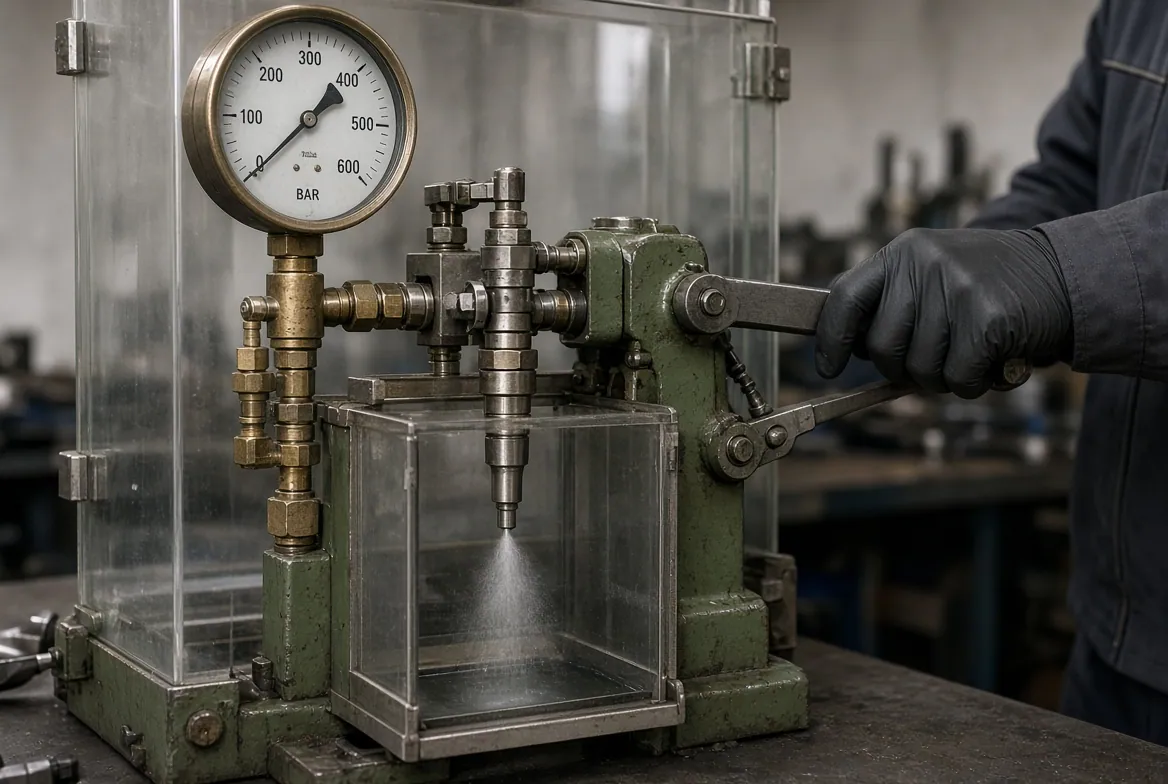
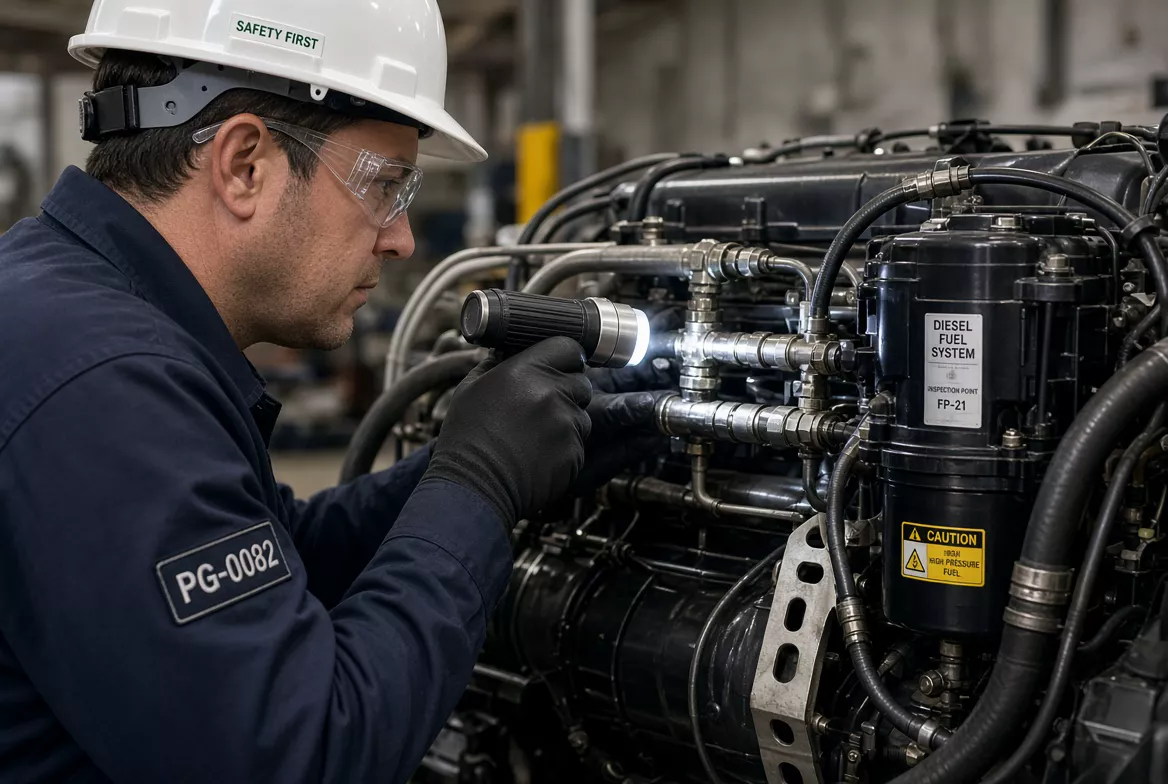
A pop test is how mechanical diesel injectors, often called nozzles, are checked. The nozzle is mounted on a hand-operated tester, pressure is raised until the spring-loaded needle lifts and fuel bursts out (the “pop”), and the technician evaluates four things: the pressure at which it opens, the spray pattern, whether the seat seals before opening, and how quickly pressure leaks away.
Injector pop testing is not a common-rail bench-test substitute
Traditional nozzle opening-pressure and spray-pattern evaluation applies to suitable mechanical injector designs. Common-rail and HEUI testing use different equipment and procedures.
- Identify the injector technology: Record the complete part number and engine family before selecting any testing method.
- Ask what the test can prove: An opening-pressure observation does not measure every injector delivery or electronic-control condition.
- Respect high-pressure safety: Do not improvise pop testing or place hands near a pressurized spray. Specialist equipment and protection are essential.
Related guidance: Professional injector-testing overview Injector technology comparisons
It is a useful specialist test for many mechanical pump-and-line nozzles, including those found on older trucks, tractors and generators. It does not establish the performance of common-rail, HEUI or electronic unit injectors, which require other supported test equipment.
How a mechanical nozzle works
Inside the nozzle holder, a spring presses a needle onto a seat. When the injection pump sends a pulse of fuel down the line, pressure builds until it overcomes the spring. The needle lifts, fuel sprays through the nozzle holes, pressure drops and the spring snaps the needle shut. The opening pressure is set by spring tension, adjusted with shims or an adjusting screw depending on design.
Everything about the injection event depends on that needle opening at the right pressure, spraying cleanly, and closing sharply.
The four checks
1. Opening pressure
The tester’s gauge shows the pressure at which the needle lifts. Each nozzle has a specified opening pressure for its application. As springs fatigue and seats wear, opening pressure usually drops. A low opener starts injecting early and at lower pressure, which hurts atomization and can cause smoke, noise and poor fuel economy. Across a set, opening pressures should be close to one another as well as close to specification.
Some engines use two-stage nozzle holders with two springs and two opening pressures, designed to soften combustion noise. Those need to be checked against both specifications.
2. Seat tightness
Pressure is held just below the opening point while the technician watches the tip. A good nozzle stays dry. One that weeps or forms a drip is leaking past the seat, which leads to dribble after injection, carbon at the tip and smoky, uneven running.
3. Spray pattern
When the nozzle pops, the spray should be finely atomized and even. On a multi-hole nozzle, each hole should produce a similar, symmetrical plume with no streams or wet streaks. On a pintle nozzle, the cone should be uniform. A plugged hole, a streaming jet or a lopsided pattern means combustion in that cylinder won’t be right.
4. Leakage and chatter
Pressure decay with the needle closed indicates internal leakage past the needle guide. Many nozzles also “chatter,” producing a buzzing sound as the needle oscillates during slow lever strokes. On designs that are expected to chatter, it’s a sign of a free-moving needle. It’s a supporting clue, not a pass/fail result by itself, because chatter behavior varies with nozzle design and how the lever is operated.
What a pop test misses
- Delivery quantity. The nozzle doesn’t meter fuel. The injection pump does. A perfect nozzle can’t fix a pump delivering the wrong amount, which is why injection pump calibration is a separate job.
- Operating-speed behavior. A hand lever can’t reproduce thousands of injections per minute at engine temperature.
- Engine-side problems. Carbon in the injector bore, a leaking sealing washer or a cracked line won’t show up on the tester.
What happens to nozzles that fail
Depending on condition, a nozzle can be cleaned and reset, rebuilt with a new nozzle tip and adjusted to opening pressure, or replaced. Where the repair plan calls for a full nozzle set, matching opening pressures to the correct application limits matters. Cylinders that differ significantly cause uneven running even if every nozzle is individually “acceptable.”
A safety note for DIY testers
A pop tester produces a needle-fine spray at thousands of psi. Fluid at that pressure can penetrate skin, and the resulting injury is a medical emergency even if it looks minor. Always aim the spray into a container, keep hands and fingers away from the tip, and wear eye protection. Atomized fuel is flammable and harmful to breathe, so work in a ventilated area away from ignition sources. Our article on high-pressure fuel injection injuries explains why this is taken so seriously.
Manufacturer reference: Bosch Aftermarket: diesel test benches and tools · UK Health and Safety Executive: fluid-injection injury For procedures and specifications, use the current manufacturer information for your engine and model year.
Send your nozzles to DCT
If your engine uses mechanical injectors and it’s smoking, knocking or running unevenly, the nozzles are a reasonable place to look, especially if they’ve never been serviced. Diesel Control Technicians tests and rebuilds mechanical injectors for trucks, farm equipment and industrial engines. First request component-specific approval. For accepted injectors, DCT provides written instructions to ship the approved, correctly labeled set or arrange approved receiving at Hutchinson or Great Bend. If the engine’s pump is also suspect, ask DCT whether a separate approved evaluation is appropriate for that exact pump.
QUESTIONS ABOUT YOUR DIESEL COMPONENT?
Have questions about Diesel Injector Pop Test: What It Shows and What It Misses?
A mechanical injector pop test reveals selected opening characteristics, not every aspect of injector condition. Understand when it is relevant and why other injector types require different tests. Include the injector or nozzle number, engine identification, relevant cylinder observations and any completed injector testing.