
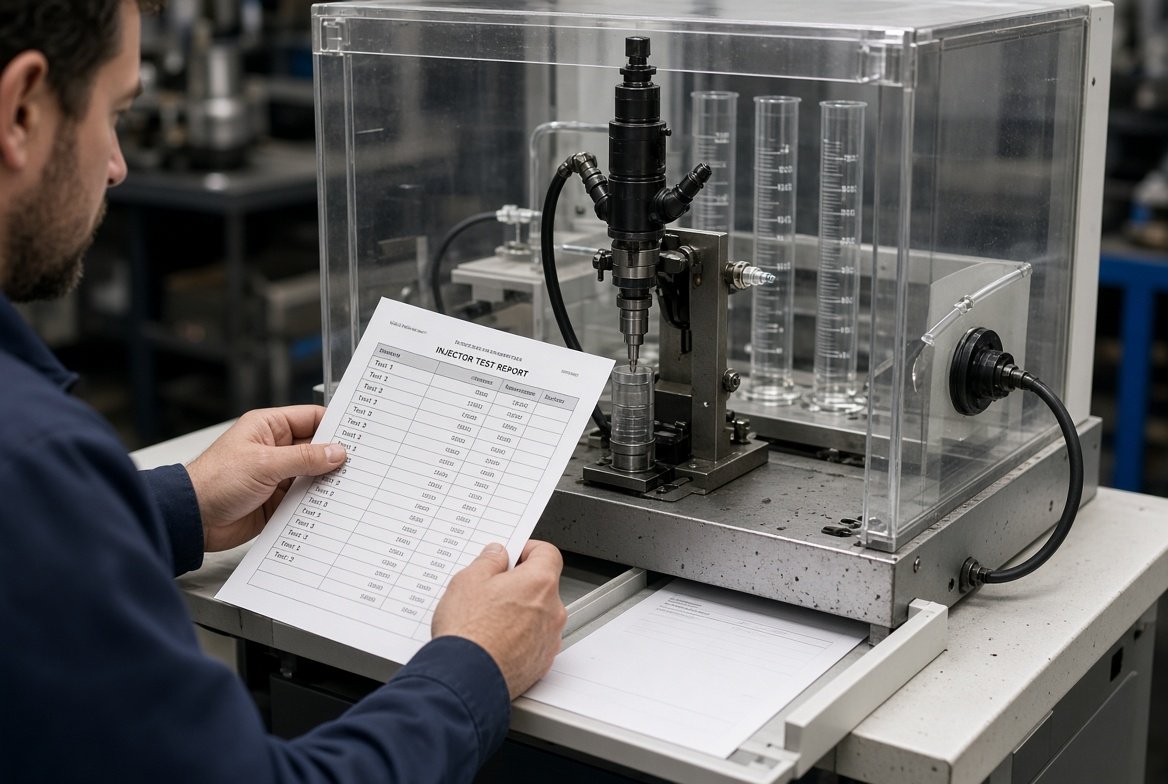
Two diesel shops can both quote an “injector test” and mean very different things. One may check electrical continuity and visible leakage. Another may run several supported delivery and return-flow points, with a report that identifies each injector. The second service may be more informative—but only if those tests apply to your exact part and the complaint you’re chasing.
Before you send a box of injectors, ask what question the test will answer and what evidence you’ll receive back. A quote should describe the work, not just the number at the bottom.
1. Confirm the full injector number
A common-rail solenoid injector, a piezo injector, an older mechanical nozzle and a HEUI injector do not use one universal test plan. Record the complete part number, engine application, quantity and original cylinder positions. If you’re unsure which marking is the part number, use our guide to finding injector identification.
Ask: Can you test this exact injector design? Don’t accept an answer based only on the engine brand. If the shop does not support the part, find that out before you pay removal labor or freight.
2. Compare test scope, not labels
| Quoted check | Useful question | What it cannot establish by itself |
|---|---|---|
| Electrical or actuator check | Which characteristics are tested for this design? | Correct fuel delivery at every operating point |
| Sealing or leak check | Is this nozzle sealing, external leakage or internal return flow? | Full injection performance |
| Delivery checks | At which supported pressure and actuation points? | Wiring or compression condition on the vehicle |
| Mechanical nozzle pop test | Are opening pressure and applicable sealing/spray checks included? | Electronic injector performance |
| Full supported test sequence | Which functions and limits are documented, and what is omitted? | Every intermittent engine-only condition |
The injector bench testing guide explains these measurements. If a test is not supported for your design, the provider should say so. “Bench tested” is not one standard package.
3. Ask to see the reporting format
A useful test report identifies each unit and, where supplied, its original cylinder. Look for measured values or clear findings, relevant criteria, test conditions, and a distinction between passed, failed, not tested and inconclusive. An electrical pass should not appear as a full hydraulic pass.
A set may contain one failed unit and several acceptable units. A single summary line hides that distinction. If the failure happens only hot or under load, ask whether the bench can reproduce a relevant condition and how that limitation will be documented.
4. Check what the quote excludes
Does the price cover evaluation only? Cleaning? A repair proposal? A completed rebuilt injector? Clarify whether any additional work requires your approval. Ask how a passing or unserviceable unit is handled, whether a testing charge still applies, and what return shipping costs.
For repair work after a failed test, use our separate injector repair quote checklist. A testing quote answers what is wrong; a repair quote answers what will be corrected and verified.
5. Send the evidence that makes testing useful
A good intake note is short and specific: “Cylinder 4 misses at hot idle, wiring and compression checked, injector number and relevant codes attached.” Save requested-versus-actual pressure, approved return-flow findings, cylinder data, and whether the complaint appears cold, hot or under load.
Don’t ship a complete set just because the symptom sounds like an injector. Have the local technician first check the appropriate supply, electrical and mechanical conditions and identify which units genuinely need off-engine assessment.
Compare the total job, not the test fee
A slightly cheaper test may be expensive if the report cannot support the next repair decision or if shipping, authorization and reinstallation work are missing from the estimate. Compare the same supported functions and the same reporting standard between providers. Keep the original report for the technician reinstalling the part.
Technical reference: Bosch Aftermarket: diesel test benches and tools. Follow the engine maker’s specific procedures and limits.
Request the test scope before shipping to DCT
Diesel Control Technicians handles supported injector evaluation and service by part number. Request a mail-in component review with your injector numbers, cylinder mapping, symptoms and existing readings. Ask which test points are available, how results are reported, and what current authorization and shipping terms apply before removing or mailing parts.