A common-rail diesel engine is remarkably precise about fuel pressure. Its controller can request a particular pressure for starting, idling, accelerating, or heavy work, then compare that request with a measured value. A rail-pressure fault appears when the relationship stops behaving as the calibration expects. The resulting code may seem to accuse one component, but the actual investigation is about an entire hydraulic and electronic system working together.
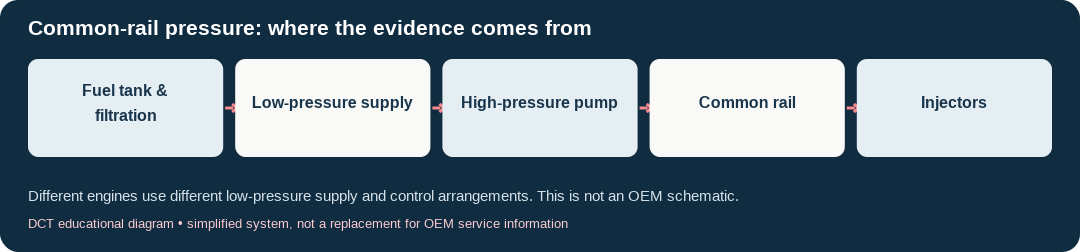
For the shop and the owner, the key question is not simply whether pressure was “low” or “high.” It is when the disagreement occurred and how the control system responded. An engine that builds adequate pressure at idle but cannot maintain it climbing a grade raises a different set of questions from one that cannot achieve its starting threshold. Likewise, a sudden high-pressure event points away from some low-supply explanations and toward metering, regulation, relief, or sensor feedback. The diagnostic context changes the meaning of the clue.
Fuel rail code quick sort: low, high, sensor and control are different
The first repair decision is to identify whether the fault describes pressure direction, sensor plausibility or the controller response.
- Low pressure: Compare P0087 and P00C6 with the operating condition.
- High pressure: Treat P0088 as a different pressure-control condition.
- Sensor performance: Use P0191 and related sensor-circuit codes to separate feedback faults from hydraulic faults.
Related guidance: P0087 low rail P0088 high rail P0191 sensor
Low pressure is not the same as a failed high-pressure pump
P0087: Fuel Rail Pressure Too Low is one of the most useful starting points, because it describes a mismatch without proving the source. A restricted filter, weak supply pump, air introduced on the suction side, incorrect fuel, a malfunctioning inlet metering valve, a leaking rail relief device, or excessive injector return flow may all affect the rail’s ability to reach or hold the requested pressure. Internal wear or failure of the high-pressure pump belongs on the list too, but it should not be the first part replaced merely because its name appears in a search result.
P008A: Low Fuel Supply Pressure describes an upstream problem where supported by the vehicle, while P00C6: Low Rail Pressure During Cranking is tied specifically to the pressure-building portion of a start attempt. Different engines do not use identical enable conditions or threshold values. A scan-tool graph of desired pressure, actual pressure, engine speed, and relevant control commands is more persuasive than a single reading captured without context.
When the pressure is too high
P0088: Fuel Rail Pressure Too High deserves just as much respect as a low-pressure fault. If actual pressure rises excessively, a technician considers the pressure-control strategy, the ability of metering and regulating devices to respond, relief-system behavior, and whether the sensor report can be trusted. Protective engine operation may be imposed to limit further risk. The wrong repair can create more problems than the original code.
Pressure-control limits and engine protection
Codes P016D, P016E, P016F, P228A, P228C, P228D, P228E, and P228F describe aspects of closed-loop response, control limits, learning boundaries, or a forced shutdown. These are not invitations to swap every valve in the fuel system. They are invitations to compare command, feedback, and operating conditions in a defined diagnostic sequence. A fault in the low-pressure supply may push the high-pressure controller against its limit even when the regulator itself is functional.
The Duramax-specific P1093 guide provides a good example of the value of operating conditions: pressure that becomes insufficient during high fuel demand can feel like a turbo problem, a transmission problem, or simply a truck that has “lost its legs.” Sorting out which system imposed the power loss prevents the wrong diagnosis.
The evidence a technician needs
A competent investigation records freeze-frame data and companion codes, checks low-side supply and fuel quality where applicable, compares rail pressure during cranking and appropriate loaded operation, and evaluates sensor and control signals. The return-flow test, relief test, or pump test chosen next depends on the architecture and OEM instructions. No single universal pressure number or homemade leak-off procedure applies to every common-rail system.
Related codes in this category
| DTC or code family | What the fault describes | Diagnostic significance |
|---|---|---|
| P0087 | Rail/system pressure too low | Actual rail pressure is insufficient versus a calibrated target; verify supply, leakage, pump control, and feedback. |
| P00C6 | Rail pressure too low during cranking | Starting-phase pressure criterion was not achieved; cranking speed and fuel delivery prerequisites matter. |
| P0088 | Rail/system pressure too high | Control-system overpressure concern; examine regulation, metering and sensor interpretation. |
| P1093 | Duramax fuel rail pressure too low during power enrichment | Manufacturer-specific Duramax use; verify engine generation and loaded demand data. |
| P016F | Closed-loop fuel pressure control at low limit | Controller reaches a pressure-related limit; investigate why sufficient pressure cannot be sustained. |
| P016E | Closed-loop fuel pressure control at high limit | Controller reaches a high-pressure control boundary; not automatic proof of a failed regulator. |
| P228C | Fuel pressure regulator 1 exceeded control limits—pressure low | Pressure control reached its available correction; evaluate supply and leakage before replacement. |
| P228D | Fuel pressure regulator 1 exceeded control limits—pressure high | Pressure high-limit behavior can involve control, feedback, or metering issues. |
| P016D | Excessive time to enter closed-loop fuel pressure control | Controller took too long to establish stable pressure regulation. |
| P228A | Fuel pressure regulator 1 forced engine shutdown | Protective shutdown fault; identify why regulation became unacceptable. |
| P228E | Fuel pressure regulator 1 learning limits too low | Adaptive control low limit; context matters more than regulator name. |
| P228F | Fuel pressure regulator 1 learning limits too high | Adaptive control high limit; check pressure strategy and related codes. |
For a closer look, read P0087, P0088, P00C6, and fuel pressure regulator faults. If you suspect a pump or injector, contact our team with the code and test data before committing to a major component purchase.
Keep exploring the right evidence
Understand P0087, P0088, P00C6 and related diesel rail pressure faults, why pressure control fails and which tests identify the real cause. Include the original high-pressure pump or injector number, engine identification and any measured supply or rail-pressure results.