
You’re accelerating onto the highway, towing up a grade, or trying to get the truck started on a cold morning. The engine hesitates or loses power, and a scan tool returns P0087: Fuel Rail/System Pressure Too Low. It is tempting to translate that into “the high-pressure pump is bad,” especially when the engine runs on a common-rail system. But P0087 describes the pressure result, not the component that caused it. Understanding that distinction can save a considerable amount of money and diagnostic frustration.
P0087: what the code says and what the code does not say
P0087 reports low rail/system fuel pressure under the controller's diagnostic criteria. It does not determine whether the supply, metering, leakage or pressure sensing caused it.
- Start with context: Save when the pressure loss occurred: crank, idle, acceleration or sustained load.
- Separate supply from demand: Use the OEM sequence for low-pressure feed, rail pressure command, actual pressure and leakage evidence.
- Use the longer diagnostic article: This page is the code reference; the linked article develops the evidence-led troubleshooting workflow.
Related guidance: Full P0087 diagnostic walkthrough P008A low-side pressure comparison
Need the complete P0087 diagnostic guide?
The quick code reference helps identify the condition. Our P0087 technical journal investigation compares the fuel supply, high-pressure pump, metering control, internal leakage and pressure-sensor evidence in a practical testing sequence.
P0087 — Rail/system pressure too low. Actual rail pressure is insufficient versus a calibrated target; verify supply, leakage, pump control, and feedback.
What to record before requesting component testing
P0087 does not identify the failed part. If a repair facility has already measured low-side supply, compared requested and actual rail pressure, or performed a supported leakage check, include those findings with the engine application and pump number. They help determine whether specialist component evaluation is relevant.
What P0087 actually means
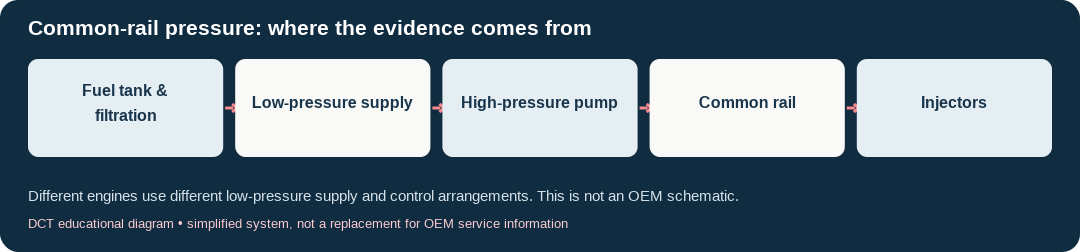
A common-rail diesel separates the generation of pressure from the act of injecting fuel. The high-pressure pump supplies a rail, the rail feeds the injectors, and the engine control module requests pressure appropriate to operating conditions. A rail pressure sensor reports how the system is behaving. P0087 can set when actual pressure fails to meet the controller’s calibrated expectation. The exact threshold, time window, and conditions vary by engine; a generic website should never attach one universal pressure specification to the code.
Think of the system as a commercial water network: the pump must supply enough pressure, the supply pipe must deliver adequate volume, the valves must regulate flow, and the outlets must not leak excessively. A low reading at the far end does not tell you which part is responsible. The analogy is imperfect because diesel injection pressures and control strategies are very different, but the diagnostic lesson holds: trace the whole path instead of pointing at the most expensive part.
Symptoms a driver may notice
Common complaints include reduced power, hesitation while accelerating, rough operation under load, a longer-than-normal crank, stalling, or a no-start. Some engines enter a protective reduced-power mode and others may store P0087 without an immediately dramatic symptom. The timing matters. A problem that appears only under heavy demand suggests that supply capacity or pressure retention may be marginal. A pressure failure from the first second of cranking leads the investigation toward starting prerequisites, return leakage, supply condition, and pump control. Neither pattern by itself proves one component is defective.
Why rail pressure can fall short
A starving supply side. A restricted filter, weak lift pump, blocked pickup, contaminated fuel, or air entering the low-pressure circuit can leave the high-pressure pump without enough clean fuel. Some engines show P008A at the same time, but the absence of P008A does not establish a healthy supply: not all vehicles monitor the low side the same way.
Fuel escaping faster than expected. Excessive internal injector return leakage, an improperly sealing rail relief device, or an actual external leak can prevent pressure from building or holding. No puddle is required for an internal leak. External leaks must be treated as a safety issue, not investigated by placing a hand near a running fuel line.
Metering, regulation, or measurement issues. A valve that does not respond to its command, incorrect electrical control, or unreliable rail-pressure feedback can produce a pressure disagreement. A damaged or worn high-pressure pump remains a possibility, particularly where the vehicle-level tests confirm proper supply and control but inadequate output. The role of each cause changes with the pump and engine design.
How a good P0087 diagnosis unfolds
First, the technician records confirmed, pending, and historical codes plus freeze-frame conditions. A P0191 sensor plausibility code or P008A supply-pressure code can change the order of investigation. Next, commanded and measured pressure are compared during cranking, idle, and approved operating conditions that reproduce the complaint. The technician verifies engine speed, fuel condition, relevant electrical supply, filter and low-pressure system performance, then proceeds to application-specific testing of pressure control, relief leakage, injector return, or pump output. The point is not to perform every conceivable test. It is to make the next measurement answer a real question raised by the previous one.
If metallic debris or other contamination is found, the investigation must also determine whether related components and lines are affected. Replacing a damaged pump without following the manufacturer’s contamination procedure can leave the next pump or injectors exposed to the same material. Conversely, if a supply restriction explains the pressure shortfall, replacing the high-pressure pump may achieve nothing.
Does P0087 mean you should park the truck?
If the engine is stalling, losing power unpredictably, or showing evidence of fuel leakage, stop using it and arrange professional assistance. Even when it still drives, continuing to demand high power from a fuel system that cannot respond properly is unwise. Never loosen high-pressure lines with the engine running or use your fingers to check for leaks; high-pressure diesel can penetrate skin and requires emergency medical treatment.
P0087 versus related codes
P008A points toward monitored low-side fuel supply. P00C6 emphasizes the cranking phase. P0191 concerns pressure-sensor plausibility, while P0088 describes the opposite pressure direction. All can involve overlapping components, but their monitor descriptions and operating circumstances are not interchangeable.
When component testing makes sense
If the supply system, wiring, pressure feedback, and controlling devices have been evaluated and the evidence still points toward the high-pressure pump or one or more injectors, professional component evaluation can help determine the next repair step. When you contact our diesel injection team, include the engine details, the P0087 freeze-frame, any related codes, and what tests have already been completed. The goal is not to sell the first part mentioned by a scanner; it is to put the repair effort where the evidence points.
P0087 frequently asked questions
Can a bad injector cause P0087?
Yes. Excessive internal fuel return on some common-rail injectors can reduce the pressure available to the rail, but the effect and the correct test vary by system. A return-flow result must be compared with the manufacturer’s conditions and limits rather than a generic internet number.
Can a clogged fuel filter trigger P0087?
It can. If filtration restriction or poor supply flow prevents the high-pressure pump from receiving the fuel it needs, the rail can fall behind demand. That is why supply checks generally precede pump condemnation.
Is P0087 the same on Duramax, Cummins, and Power Stroke?
The broad message—insufficient rail/system pressure—is similar on equipped common-rail engines, but sensors, pumps, valves, pressure thresholds, test methods, and companion codes differ. Use our Duramax, Cummins, or Power Stroke guide for the appropriate generation.
Keep exploring the right evidence
P0087 means fuel rail pressure did not meet the expected target. Learn how supply restrictions, injectors, pumps and pressure control are diagnosed. Include the original high-pressure pump or injector number, engine identification and any measured supply or rail-pressure results.