
P0201 means Injector Circuit/Open – Cylinder 1. P0202 through P0208 are the same fault for cylinders 2 through 8. The engine computer, or a separate injector driver module, saw an electrical signal from that injector’s circuit that doesn’t match what a healthy circuit should produce. That points to the circuit, which includes the injector’s coil or actuator, but also the connector, the harness and the driver that powers it.
P0201 code: a cylinder-1 control circuit is not a spray-pattern test
P0201 identifies an injector circuit fault for the engine-defined cylinder 1, not a measurement of injector fuel flow.
- Start with electrical evidence: Review connector and harness conditions and follow the OEM electrical workflow.
- Locate the correct cylinder: Use the vehicle wiring diagram and cylinder numbering rather than a generic diagram.
- Leave mechanical conclusions open: A mechanical injector fault requires separate fuel-delivery or bench evidence.
Related guidance: Full P0201–P0208 group Injector test methods
Before replacing an injector for a circuit code, prove the problem isn’t in the wiring. Often it is.
Related codes you may see
- P0261, P0264, P0267 and so on: injector circuit low for a specific cylinder
- P0262, P0265, P0268 and so on: injector circuit high
- P0263, P0266, P0269 and so on: cylinder contribution or balance, which is a performance code rather than an electrical one
If you have a circuit code and a balance code on the same cylinder, the electrical fault is probably causing the balance problem.
How the computer detects a circuit fault
When an injector fires, the driver sends a controlled current or voltage pulse and monitors how the circuit responds. An open circuit, a short to ground, a short to power or a coil with the wrong resistance changes that response. The computer sets a code and may shut off that injector to protect the driver.
Where the fault usually is
Connectors. Corroded, loose, backed-out or damaged pins are common, especially on engines with connectors exposed to heat and vibration.
Harness damage. Wires chafed against brackets, the valve cover or engine components. On engines where the injector harness runs under the valve cover, such as the 7.3 and 6.0 Power Stroke and the LB7 Duramax, the harness and its pass-through connector live in a hot, oily environment and are a known weak point.
The injector’s actuator. A solenoid coil can open or short. A piezo stack can fail electrically.
The driver. On engines with a separate injector driver module, such as the injector driver module on the 7.3 Power Stroke or the FICM on the 6.0, the module itself or its power supply can fail. The 6.0’s FICM, for example, needs to deliver roughly 48 volts to the injectors, and low battery voltage can damage it. See 6.0 Power Stroke injector problems.
A diagnostic sequence
- Note which cylinders are affected. One cylinder points to that injector or its wiring. Several cylinders, especially ones that share a driver bank or harness section, point to a shared component.
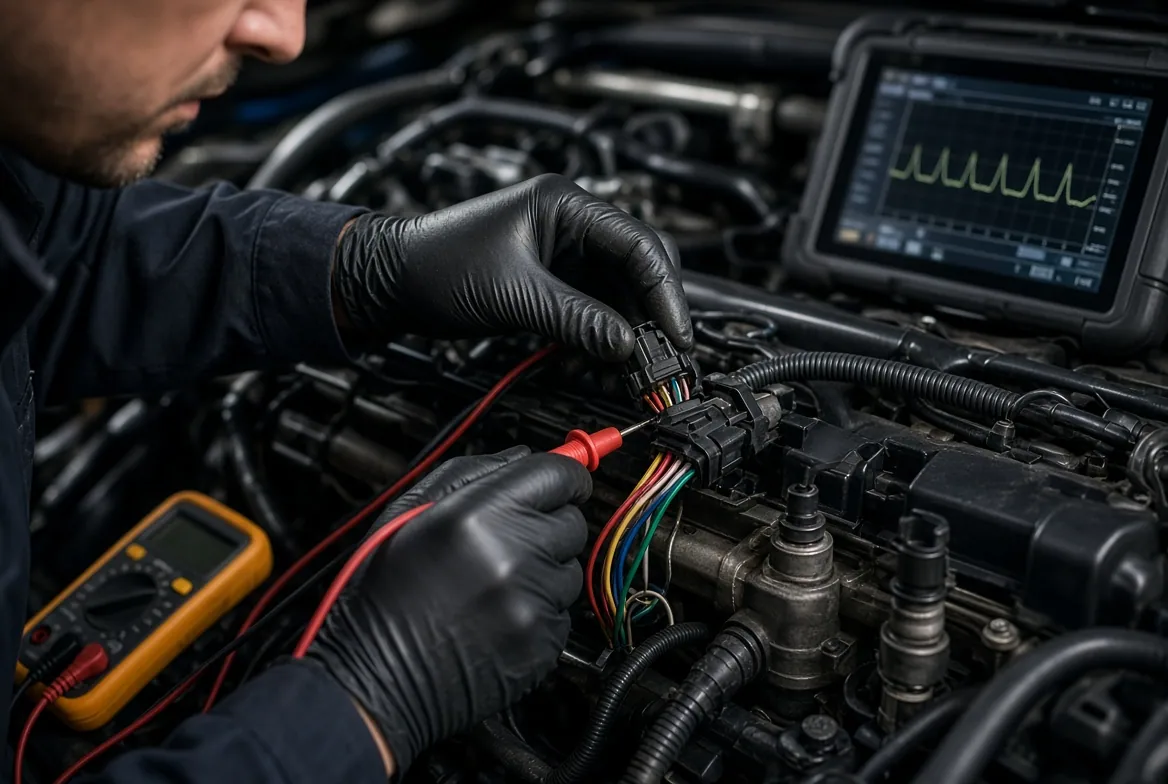
- Inspect the connector at the injector and at the computer or driver module.
- Measure resistance with the specified procedure, first at the harness connector and then directly at the injector. If the injector measures correctly but the circuit doesn’t, the wiring is the problem. Compare against other cylinders and the specification.
- Check for shorts to ground and to power in the harness.
- Check the driver’s power supply, including battery and charging system voltage on engines that use an injector driver module.
On piezo-injector engines, follow the engine maker’s procedure. Piezo circuits operate at higher voltage, and some tests require specific equipment.
About swapping injectors
Moving the suspect injector to another cylinder and seeing whether the code follows it is a classic test. On many common-rail engines, though, injector trim codes are stored by cylinder, so swapped injectors must be recoded. Swapping also means opening the high-pressure system and, on many engines, replacing seals or connector parts. Electrical testing is usually the cleaner first step. See diesel injector coding.
When it really is the injector
If the injector’s coil or actuator measures out of specification directly at its terminals, the injector has an electrical failure. Hydraulic condition doesn’t matter at that point: it needs repair or replacement. If the injector measures fine electrically but the code returns, look harder at the circuit, or have the injector bench tested under operating conditions, since some faults appear only when the actuator is hot or firing rapidly.
Manufacturer reference: Bosch Mobility: common-rail system overview For procedures and specifications, use the current manufacturer information for your engine and model year.
Have DCT test the injector or the circuit
Diesel Control Technicians performs on-vehicle service in Hutchinson by confirmed appointment, where the circuit and the injector can be checked together. If you’ve removed an injector with a circuit code, share the injector number and exact code so DCT can confirm whether a removed-component evaluation and approved receiving are appropriate. A suitable component test may help assess an injector actuator, but engine-side wiring and control faults must be evaluated separately.
An injector circuit code is not proof of a bad nozzle
Circuit checks and the exact engine application matter before a component is condemned. When an injector evaluation is justified, include the injector identification and documented electrical findings.
QUESTIONS ABOUT YOUR DIESEL COMPONENT?
P0201 Diesel Injector Circuit Codes: Wiring or Injector?
P0201 concerns the cylinder-one injector circuit, not automatically the injector’s mechanical condition. Review wiring, driver, connector and application-specific checks before choosing a component. Include the injector or nozzle number, engine identification, relevant cylinder observations and any completed injector testing.