
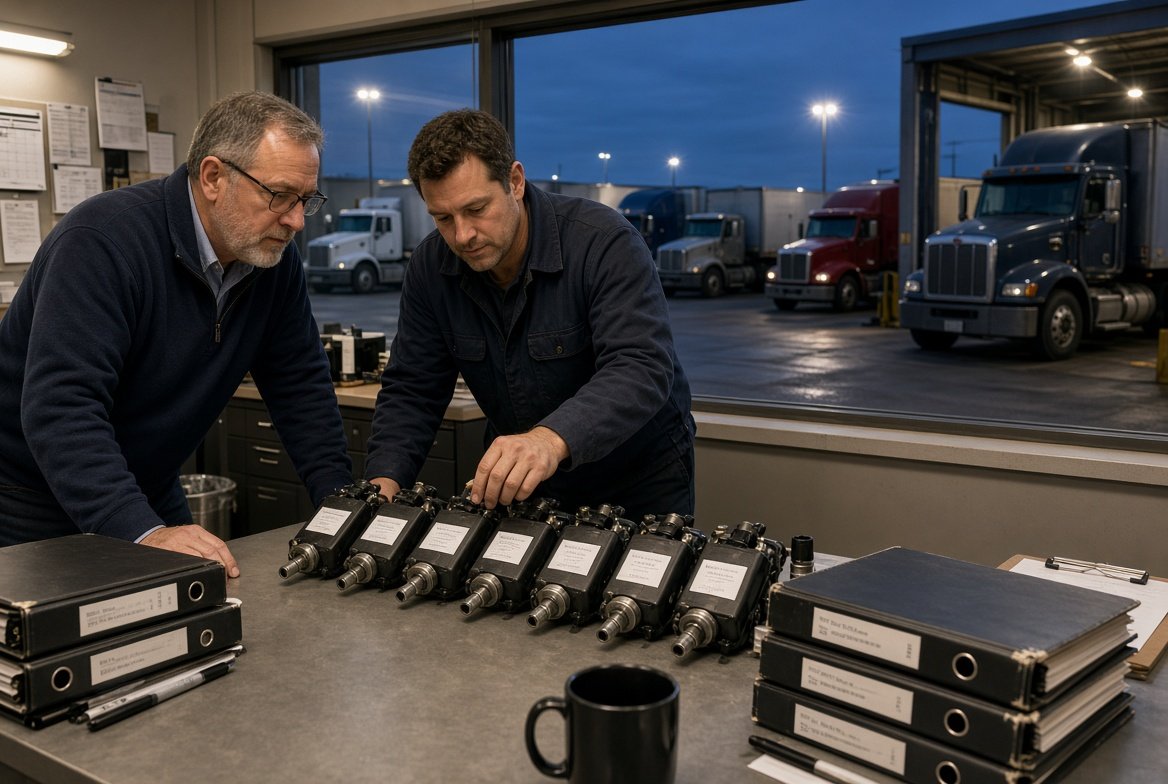
In a fleet, injector and pump failures aren’t a question of if. With enough units and enough hours, some will fail. What a fleet controls is how long each failure keeps a unit out of service. The fleets that keep that time short do five things: they know their part numbers before anything fails, plan exchanges for their most common engines, test at scheduled service instead of waiting for breakdowns, track failures to find root causes and manage fuel quality across the operation.
Where downtime actually goes
A fuel injection repair has several stages, and each one adds time:
- Diagnosis
- Removal
- Transit to the specialist
- Testing and repair
- Transit back
- Installation, coding and verification
Fleets often focus on stage 4, the shop’s turnaround, but the other stages add up. A slow diagnosis, a missing part number, a box that sits at a terminal over a weekend or an installation that misses a coding step can each add a day or more.
1. Know your part numbers now
For every unit, record the engine model and serial number, and the injector and pump part numbers. Keep it in your maintenance system. When a unit goes down, you can check exchange availability and order immediately instead of reading tags on a disabled vehicle. See diesel injector part numbers and injection pump identification.
2. Plan exchanges for your critical engines
For the engines that make up most of your fleet, or that power your most critical units, know whether exchange injectors and pumps are available, how fast they arrive and what the core-return terms are. For some fleets, keeping a tested spare set for their most common engine makes sense. See diesel injector exchange programs.
3. Test at scheduled service
Units that show early warning signs, such as balance rates drifting, slower starts, more smoke or falling fuel economy, can have injectors tested during planned downtime instead of failing on a route or job. At in-frame overhaul, make the injector decision deliberately. See replacing injectors during an in-frame overhaul.
4. Track every failure
Record each injector and pump repair by unit: date, mileage or hours, part numbers, supplier, test results and suspected cause. Patterns emerge:
- Failures clustered after a fuel delivery point to fuel quality
- Repeated failures on one unit point to a unit-specific cause, such as supply, wiring or a cup leak
- Early failures from one source point to replacement quality
- Failures concentrated in one engine family may justify a different maintenance approach
Mixed fleets especially benefit, because problems hide across different engines. The same approach works for small railroads; see locomotive and rail fuel injection. For over-the-road tractors, see Detroit DD15 injector problems.
5. Manage fuel across the operation
Fuel contamination is the biggest preventable cause of injection failures. Fleet fuel management includes:
- Regular checks for water and sediment in bulk tanks
- Filtration at the dispenser
- Supplier quality reviews
- Clear procedures for job-site fueling and cans
- Training to prevent DEF and gasoline mix-ups
See water in diesel fuel and DEF in the diesel tank.
Shipping logistics that save days
- Ship early in the day and early in the week
- Use expedited service when downtime justifies it
- Include complete paperwork in every box
- Contact the specialist before shipping so the job is expected
A simple record for each repair
Whatever system you use, capture the same fields every time:
- Unit number, engine model and serial number
- Date and mileage or hours
- Component and part numbers removed and installed
- Supplier and type: new, remanufactured, rebuilt or exchange
- Test results on the removed parts
- Suspected cause and what was done about it
- Downtime, from failure to return to service
After a year of consistent records, you’ll know where your fleet’s downtime really comes from.
Further technical reference: Cummins: diesel fuel storage and transfer. Use the exact engine/injector/pump service information for applicable procedures and limits.
Pick your partner before the emergency
The worst time to find a fuel injection specialist is when a unit is down. Diesel Control Technicians receives component inquiries for over-the-road trucks, school buses, agricultural and construction equipment, generators and related engines. Contact DCT about the exact fuel-injection part, the current repair or exchange options, realistic evaluation and turnaround timing, and the pre-shipping approval process. Confirm receiving details for the appropriate Kansas facility before traveling.
Plan the next service step: Request a mail-in component review with the engine and component IDs, known test results and downtime needs. Confirm supported scope, approvals and the current schedule.