
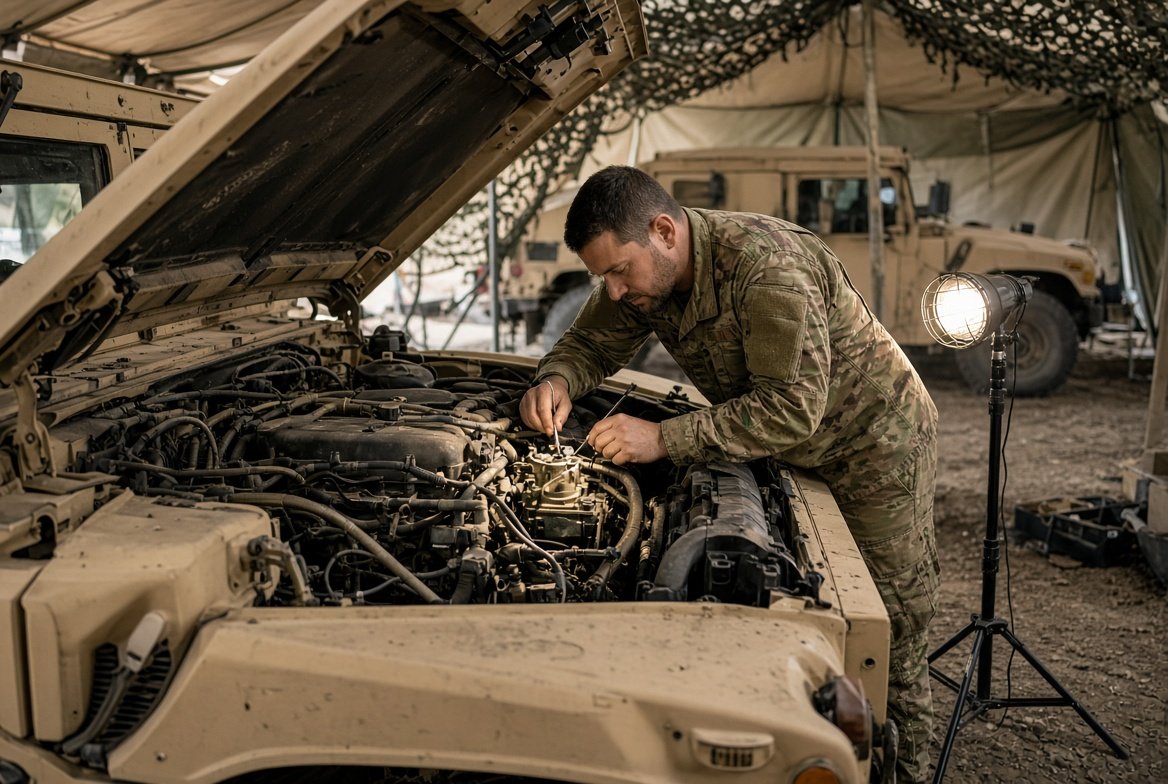
Military diesel vehicles and equipment share technology with civilian engines, but their fuel injection systems were often chosen for simplicity, ruggedness and tolerance of multiple fuels. The GM-designed 6.2 and 6.5 diesels in military HMMWVs used fully mechanical Stanadyne DB2 pumps, unlike the electronic DS4 used on civilian 6.5 trucks from 1994. The LDT-465 multifuel engine in later M35A2 cargo trucks was designed to run on a range of fuels and carries a fuel density compensator that adjusts fueling automatically. Surplus owners, collectors and fleets operating these vehicles face aging pumps, long storage and parts that require specialized knowledge.
HMMWV: 6.2 and 6.5 with the DB2
The DB2 on military HMMWVs is a mechanical rotary pump with a governor and automatic advance, lubricated by the fuel passing through it. Its typical problems mirror those on civilian DB2 pumps:
- Hard starting when hot from internal wear
- Leaks at the throttle shaft seals and covers
- Timing advance problems causing white smoke and poor running
- Shutoff solenoid failure causing a no-start
- Governor wear causing poor idle and speed control
See Stanadyne DB2 injection pump for the full picture. Because military pumps may differ from civilian versions in calibration and details, record the pump’s tag information exactly.
Multifuel engines
The LDT-465 multifuel engine in later M35A2 trucks was built to run on diesel as its primary fuel, with kerosene, jet fuel, gasoline and other fuels as alternates, and a fuel density compensator that adjusts fueling for the fuel in use. Owners are commonly advised not to adjust a factory-configured multifuel engine for fuel type, because the compensator handles it. Trucks whose compensators have been bypassed are marked for diesel fuel only.
For service, that means the injection pump and its compensator are a system. A pump rebuilt or adjusted without regard to the compensator won’t behave as intended.
Fuel considerations
Jet fuel and lubricity. Military logistics have long favored a single fuel for many vehicles, and jet fuels used that way generally have lower lubricity than diesel. Older fuel-lubricated pumps are sensitive to lubricity, so owners of ex-military equipment pay close attention to what they burn. See ULSD lubricity and older injection pumps.
Long storage. Surplus vehicles often arrive after long storage, with degraded fuel, water in the tanks and dried-out seals. Before trying to start one:
- Drain and inspect the fuel tank
- Replace filters and inspect lines
- Check for water and rust in the system
- Bleed the system completely
- Don’t force a stuck pump
Generators and other equipment
Military-pattern generators and support equipment use a range of small and medium diesels with mechanical or electronic injection. The same storage problems apply: stale fuel, water and corrosion. See standby generator fuel injection.
Documentation matters
Military vehicles were supported by detailed technical manuals, and those manuals, along with the pump’s tag, are the best references for specifications and procedures. Record the pump and injector part numbers, and keep the original data plates with the components.
Bringing a surplus vehicle back
- Record the pump and injector numbers and data plates before anything is removed.
- Don’t try to start it until you’ve looked at the fuel. Drain the tank and inspect what comes out.
- Replace all fuel filters and inspect lines for cracks and deterioration.
- Check the engine oil and coolant for contamination.
- Bleed the fuel system completely.
- If the pump is stuck or leaking, have it serviced rather than forcing it.
- Have the injectors tested if the engine runs rough or smokes once it starts.
Further technical reference: Bosch: Diesel Repair Network and supported component service. Use the exact engine/injector/pump service information for applicable procedures and limits.
Military components and DCT
Diesel Control Technicians works on fuel injection systems for military applications. Send DCT photos of the pump and its tag, along with the vehicle or equipment model, and we’ll tell you what we can do and how to ship it. Owners near Hutchinson and Great Bend, Kansas, can bring the pump in by appointment.
Ask about pump or fuel-system service: Request a mail-in component review with the pump tag, engine application and diagnostic findings. Confirm supported testing or repair, intake terms and current timing.